





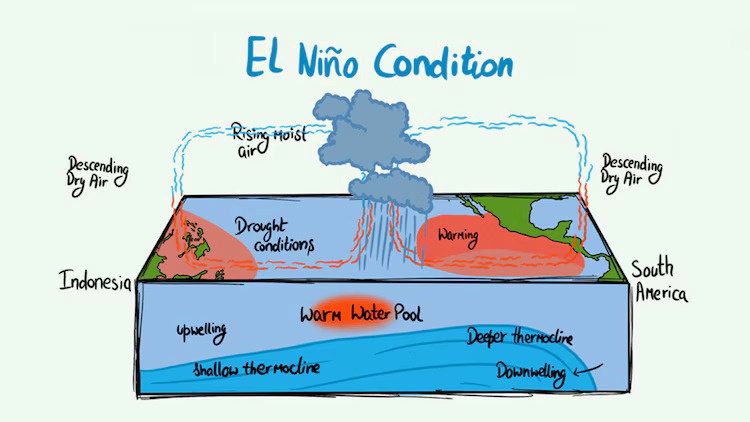
March 2026 has delivered fresh warning signs about the accelerating pace of global warming. According to recent reports, Arctic sea ice extent fell 5.7% below normal, marking the lowest level ever recorded for March. At the same time, global surface temperatures between January and March ranked as the fourth-highest on record. Moreover, March itself became the fourth-warmest globally, with temperatures reaching 1.48°C above pre-industrial levels. In addition, sea surface temperatures (SST) climbed to 20.97°C, making it the second-highest ever observed, just behind the 2024 El Niño peak.
Record sea temperatures signal El Niño
Meanwhile, scientists have highlighted a rapid increase in ocean temperatures. According to the Copernicus Climate Change Service (C3S), daily SST levels are now approaching the record highs seen in 2024. As a result, several climate models are predicting a shift from neutral conditions to El Niño by July.
Similarly, the US NOAA’s National Centers for Environmental Information reported that March temperatures were 1.31°C above the 20th-century average. This ties 2024 as the second-warmest March, while 2025 remains the warmest by a narrow margin of 0.01°C. Notably, all of the ten warmest March records since 1850 have occurred after 2015, underscoring a clear warming trend.
Also Read : Javokhir Sindarov stuns R Praggnanandhaa Women’s race tightens
Regional impacts and growing concerns
On the regional front, Europe recorded its second-warmest March, along with notably drier conditions. This follows a colder and wetter February, which was among the coldest in the past 14 years. At the same time, significant heat anomalies were observed across the western United States, much of the Arctic, northeast Russia, and parts of Antarctica. In contrast, cooler-than-average conditions persisted in Alaska, most of Canada, southern Greenland, and northwest Siberia.
Furthermore, climate experts have raised serious concerns over these developments. Copernicus director Carlo Buontempo stated that the combined data reflects a climate system under increasing and sustained pressure. He emphasized that reliable data from satellites, ships, and weather stations is now essential for effective climate policy and adaptation strategies.
Looking ahead, NOAA’s Climate Prediction Center forecasts an 80% chance of ENSO-neutral conditions through April to June 2026. However, the likelihood of El Niño rises to 61% between May and July, and is expected to persist with an 80% probability through August and 85% into September.
Finally, former Earth Sciences Ministry secretary M Rajeevan warned that global warming is continuing without slowdown, largely due to rising greenhouse gas emissions. He added that a potential El Niño event this year could further intensify heat levels and increase the risk of severe heatwaves, stressing that time to act is rapidly running out.
Also Read : India Hits Nuclear Criticality, Termed ‘Akshay Patra Moment’




More Stories
Kerala Man Bludgeons 18-Year-Old Lover With Stone, Sets Body On Fire
केरलम: ब्रेकअप से नाराज प्रेमी ने प्रेमिका की पत्थर से कुचलकर हत्या की, शव जलाया
3 साल की बेटी पर झपटा तेंदुआ तो पिता बना ढाल, पीछे से दबोच लिया; ड्रोन और पिंजरे भी रहे बेअसर