





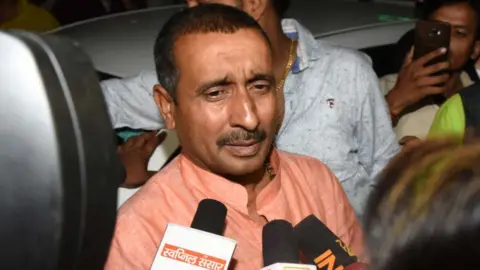
The High Court did not ground its order in any prima facie assessment of innocence. Instead, it relied on a hypertechnical interpretation concerning the alleged misclassification of the offence.
The Delhi High Court’s recent decision to suspend the sentence of former BJP MLA Kuldeep Singh Sengar in the Unnao rape case has raised serious concerns. The Court diluted the gravity of the offence by adopting a strictly textual interpretation of the term “public servant.” It held that a sitting MLA does not fall within the definition of a “public servant” under Section 21 of the Indian Penal Code. On this basis, the Court ruled that Section 5(c) of the Protection of Children from Sexual Offences (POCSO) Act, 2012—which treats sexual assault by a public servant as an aggravated offence—does not apply. The Court also excluded the applicability of Section 376(2) of the IPC, which similarly categorises rape by a public servant as an aggravated offence. Consequently, it concluded that the life sentence imposed under these provisions could not stand.
Although the Court’s view that an MLA does not qualify as a “public servant” under Section 5(c) of the POCSO Act may appear defensible on a strictly literal reading—since the Act adopts the IPC definition—this conclusion does not resolve the matter. Even without invoking Section 5(c), the law allows courts to convict Sengar for penetrative sexual assault of a minor under Section 4 of the POCSO Act, which carries a punishment extending to life imprisonment. Likewise, Section 376 of the IPC independently prescribes life imprisonment for the offence of rape.
Even if one accepts the Court’s interpretation regarding the inapplicability of Section 5(c), suspending the sentence remains difficult to justify under settled principles governing sentence suspension in cases involving life imprisonment for grave sexual offences.
Also Read: Bihar man arrested for marrying three women in three years without divorcing any
Case background and context
The 2017 Unnao rape case does not represent an ordinary criminal prosecution. Authorities registered the FIR only after sustained public protests by the survivor, including her extreme act of attempting self-immolation outside the Chief Minister’s residence. Law enforcement arrested Kuldeep Singh Sengar in 2018 only after the Allahabad High Court intervened and expressed concern that government officials and the law-and-order machinery were acting under his influence.
The case exposed a sustained pattern of intimidation enabled by political power and misuse of authority. Individuals repeatedly targeted members of the survivor’s family. Authorities arrested her father on questionable charges, assaulted him in custody, and he later died. In March 2020, a trial court sentenced Sengar to ten years’ imprisonment under Section 304 (Part II) of the IPC for culpable homicide in connection with the father’s death.
In 2019, after a truck rammed into a car carrying the survivor and her relatives while they were travelling to court an incident initially suspected to be staged—the Supreme Court transferred the trial from Uttar Pradesh to Delhi. Although a Delhi court later ruled out foul play, the trial court, while convicting Sengar in December 2019, recorded that the accused had threatened the survivor into silence and that his associates had systematically targeted her family to deter her from pursuing justice. These circumstances form the core of the case and must guide any judicial assessment of whether to suspend a life sentence. Treating the matter as a routine appeal ignores the extraordinary conditions that necessitated continuous judicial intervention.
Suspension of sentence in life imprisonment cases
The law on sentence suspension stands well settled. Courts generally grant suspension in cases involving fixed-term sentences, but they treat suspension as an exception in cases of life imprisonment. Once a court convicts a person and imposes a life sentence, the presumption of innocence no longer applies. The Supreme Court has repeatedly reaffirmed this principle and has recently criticised High Courts for suspending sentences casually in serious cases.
In Chhotelal Yadav v. State of Jharkhand, the Supreme Court held that an appellate court may suspend a life sentence only when the convict demonstrates a glaring or fundamental error in the trial court’s judgment that prima facie points toward acquittal. The key issue, therefore, is whether the exclusion of Section 5(c) alone justifies suspension. In Sengar’s case, even without Section 5(c), substantial grounds exist for conviction under Section 4 of the POCSO Act. The High Court failed to examine whether excluding Section 5(c) would inevitably lead to acquittal.
Gravity of the offence and role of the accused
A major flaw in the High Court’s reasoning lies in its refusal to assess whether the facts support conviction under Section 4 of the POCSO Act. The Court declined to examine this issue, stating that it became unnecessary once it found Section 5(c) inapplicable. This approach contradicts established Supreme Court precedent, which requires courts to consider both the seriousness of the offence and the role of the accused while deciding on sentence suspension.
In Rajesh Upadhyay v. State of Bihar and Vijay Kumar v. Narender, the Supreme Court emphasised that appellate courts must reach a prima facie conclusion that the convict stands a reasonable chance of success on appeal. In Omprakash Sahni v. Jai Shankar Chaudhary (2023), the Court clarified that suspension is justified only when the prosecution’s case appears vulnerable to eventual acquittal. Similarly, in Jamanlal v. State of Rajasthan (2025), the Court held that minor gaps or inconsistencies in the prosecution’s case cannot justify suspension unless the conviction itself appears unsustainable at first glance.
In this case, the High Court granted relief solely on the technical exclusion of Section 5(c). It made no prima facie finding that the offence of penetrative sexual assault under Sections 3 and 4 of the POCSO Act does not stand. The Court further reasoned that it could grant relief even if Section 4 applied, since the convict had already undergone the minimum sentence of seven years. This reasoning ignores the fact that Section 4 permits punishment up to life imprisonment.
Threat to the victim and broader concerns
Courts must also consider the potential threat to the survivor while deciding on sentence suspension. In this case, the record itself documents a history of intimidation, violence, and systematic attempts to silence the survivor and her family. The death of the survivor’s father, allegations of witness intimidation, and the extraordinary security measures during trial remain undisputed. Despite this, the High Court dismissed these concerns by observing that it cannot keep a convict in custody merely on the assumption that the police may fail to perform their duties.
By adopting a narrowly technical approach and sidelining the gravity of the offence, the entrenched abuse of power, and the proven history of intimidation, the High Court’s order raises serious concerns. The decision marginalises the survivor’s lived reality and weakens established safeguards governing sentence suspension in cases involving extreme seriousness and systemic misuse of authority.
Also Read: U.S. carries out strike on Islamic State militants in northwest Nigeria




More Stories
नेपाल में बालेन शाह की पार्टी RSP ने दर्ज की बड़ी जीत अन्य पार्टियां काफी पीछे
IND vs NZ T20 World Cup Final: What Kind of Pitch Will Ahmedabad Offer
कौन हैं मोजतबा ख़ामेनेई, जिन्हें अगल सुप्रीम लीडर माना जा रहा है