





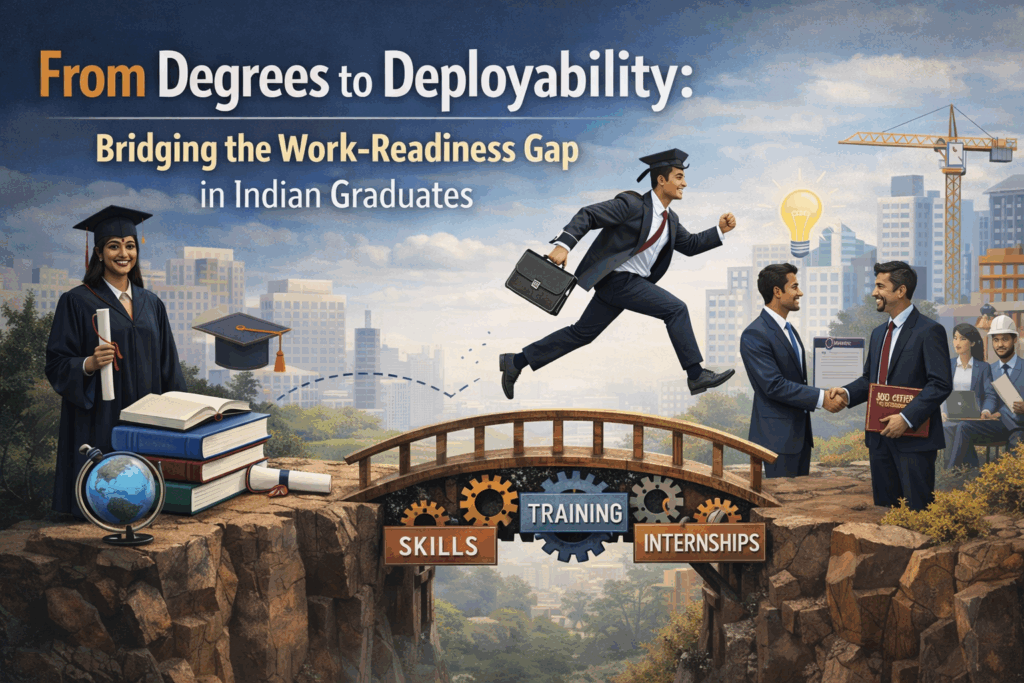
The Indian Council for Technical Research & Development (ICTRD) continued its thought leadership on
education and workforce reform by convening its third Virtual Round Table on “From Degrees to
Deployability: Bridging the Work-Readiness Gap in Indian Graduates” on 20 December 2025. At a time
when India produces one of the world’s largest graduate cohorts, the discussion squarely addressed a
growing concern: while degrees are abundant, deployable skills remain scarce. The forum brought
together academicians, industry leaders, policymakers, skilling experts, and students to deliberate on how
India can transition from a degree-centric system to a competence-driven education ecosystem aligned
with industry realities and the aspirations of NEP 2020.
Bridging the Gap Between Academic Achievement and Real-World Work Readiness
Employability today is defined less by certificates and more by adaptability, critical thinking,
communication, and practical problem-solving. The widening gap between academic outcomes and
workplace expectations impacts not only individual careers but also national productivity and
competitiveness. The round table is part of ICTRD’s broader mission to create collaborative platforms
where academia, industry, and policy can jointly design actionable solutions to improve graduate
readiness.
In his opening remarks, ICTRD Chairman Ashish Sasankar underscored that the employability challenge
goes far beyond technical knowledge. He outlined a multidimensional work-readiness gap encompassing
communication, collaboration, adaptability, emotional intelligence, ethics, and real-world exposure. As
education enters an era shaped by AI, robotics, design thinking, and digital tools, he argued that
institutions must move decisively from theory-heavy instruction to experiential and innovation-driven
learning environments. He called for a collective responsibility- academia modernising curricula, industry
acting as co-educators, policymakers enabling thoughtful reform, and students adopting a mindset shift
from job seekers to problem solvers and contributors.
Reinforcing this direction, ICTRD Member Secretary Ketan Mohitkar positioned “Degrees to
Deployability” as both a national challenge and a defining opportunity. He stressed that the crisis of
unemployability is not caused by technology or AI, but by misalignment between education and workplace expectations. Calling for strong city-level networks, he urged ICTRD members to act as
ambassadors—building collaborations among institutions, training centres, startups, and industry
professionals—to ensure that education leads to opportunity and degrees translate into deployability.
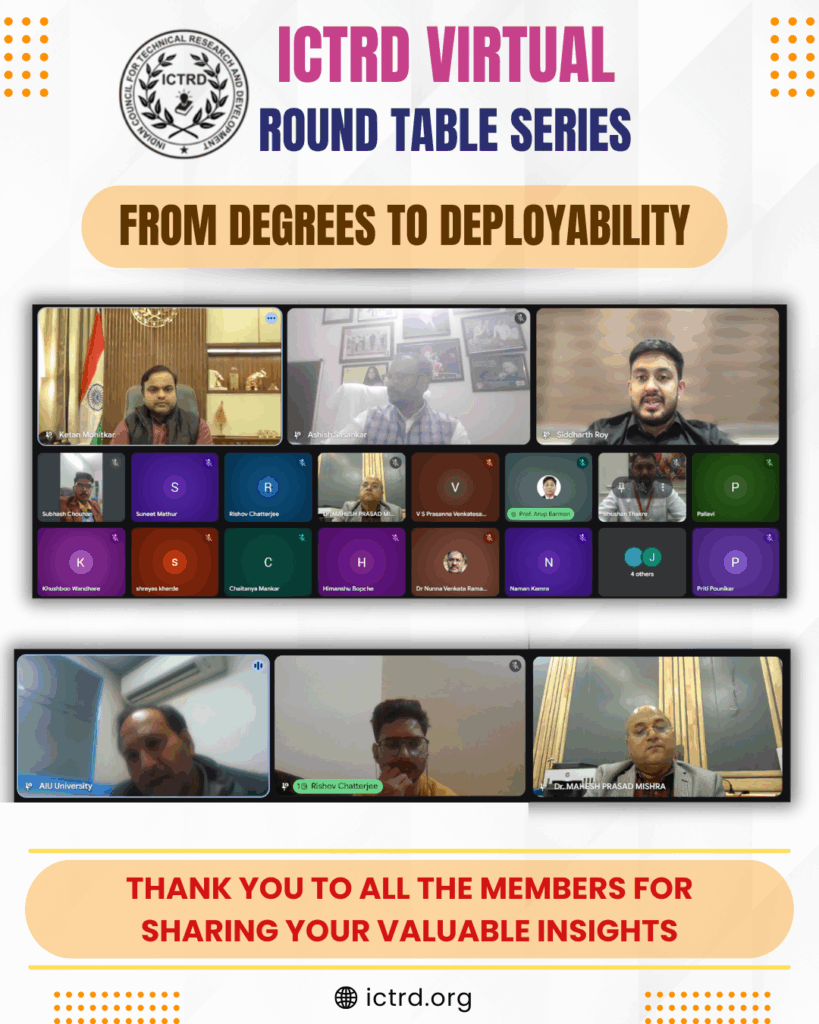
ICTRD Positions Education Reform as a National Economic Imperative
Speaker interventions provided sharp, ground-level insights into the structural gaps. Suneet Mathur drew
from his corporate-to-academia journey to highlight the persistent disconnect between curricula and
industry needs, particularly in communication and applied skills. He advocated frequent curriculum
updates, faculty immersion in industry, and year-long student engagement with corporates and SMEs to
replace superficial exposure with meaningful project work. Vikas Oberoi emphasised mentorship as a
missing link, noting that skill-based hiring is replacing degree-based screening and that institutionalised
mentoring is essential to prepare students for real-world expectations.
Adding a policy and governance perspective, Murari Lal Gaur drew a critical distinction between
employability and deployability, arguing that industry measures readiness by day-one performance rather
than marks or CGPA. He called for competence-centric education and experimental learning models that
immerse students in real contexts. From the grassroots, Subhash Chouhan highlighted that
employability challenges are equally acute in small towns and rural institutions, citing gaps in practical
exposure, career awareness, and soft skills. Manimekalai Narayanan stressed the role of NEP in modernising curricula and urged students to become proactive, lifelong learners, leveraging open
resources and continuous skill development.
The interactive discussion further reinforced that exam-driven, mark-oriented systems fail to produce
work-ready graduates, and that reform must begin early – reshaping mindsets, curricula, and
assessments across the education pipeline. Participants collectively agreed that bridging the work-
readiness gap is not merely an education issue but a national economic priority.
The round table concluded with a unified commitment to reposition education as a platform for capability, confidence, and purpose. Through initiatives like this, ICTRD continues to strengthen its standing as a premier national think tank—shaping the education-to-employment discourse, enabling cross-sector collaboration, and driving India’s transition toward an innovation-driven, deployable, and inclusive workforce.




More Stories
C.V. Ananda Bose Resigns Ahead of Bengal Polls
Iran Crisis Hits India Through Oil and Remittances
Netanyahu gains support at home during Iran war but risks global backlash