





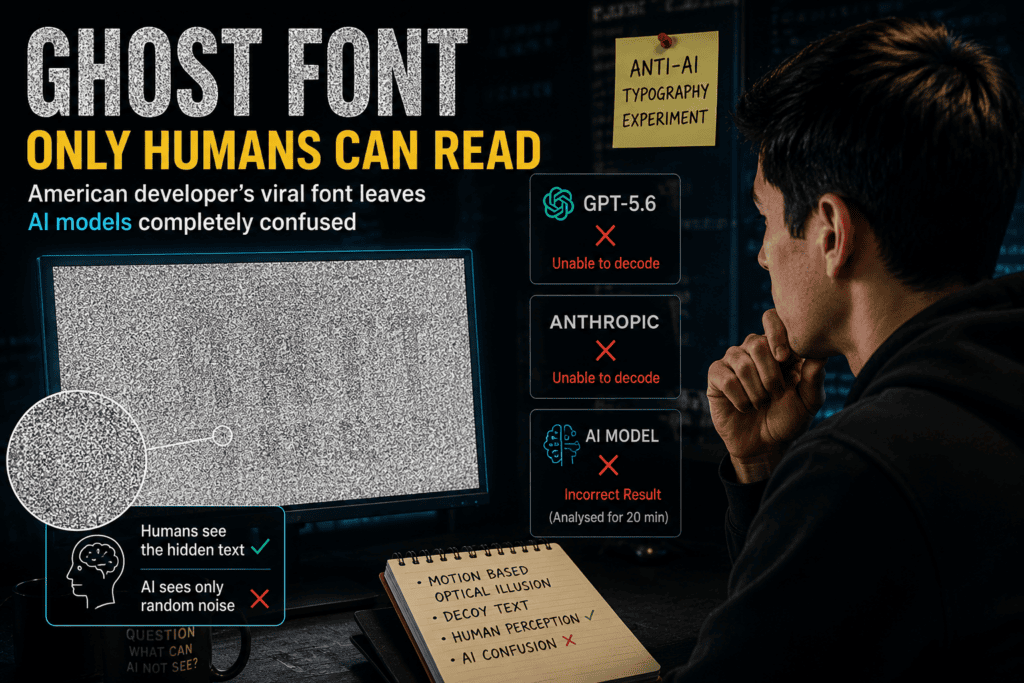
The rapid rise of artificial intelligence has pushed companies and developers to build increasingly powerful systems capable of understanding text, images and videos. However, some creators are also experimenting with ways to keep certain information beyond AI’s reach. American designer and developer Eric Lu has joined this effort with an experimental project called “Ghost Font,” which aims to highlight possible limitations in the way current AI systems process visual information. At a time when advanced AI models can analyse handwritten notes, scanned documents and unclear screenshots, Lu claims to have developed a system that people can read but AI models struggle to interpret. The project recently attracted widespread attention on social media after Lu shared his experiments online. According to his claims, he tested Ghost Font against advanced AI systems, but they failed to correctly identify the concealed message.
Also read: Anurag Kumar to Replace Satish Golcha as Delhi Police Commissioner: Know the IPS Officer
How Does the Ghost Font Work?
Ghost Font works differently from an ordinary typeface because it does not rely on clearly visible letter shapes. Instead, the experimental system uses a motion-based optical illusion involving thousands of tiny moving dots. The dots forming the hidden letters travel in one direction, while the surrounding dots move in another. As the animation runs, the human brain naturally groups dots with similar movement patterns, allowing viewers to recognise words even though traditional letter outlines are not visible. However, when someone pauses the animation, the hidden message effectively disappears and the screen appears to contain only random visual noise. This difference between static frames and continuous motion is central to the experiment. The project also reportedly introduces decoy text designed to confuse AI systems.
Lu said he tested videos created using Ghost Font with advanced artificial intelligence models to see whether they could identify the hidden messages. According to his account, the systems initially failed to correctly interpret the motion-based text unless they received additional instructions explaining how the illusion worked. In one reported experiment, another AI model spent nearly 20 minutes analysing a Ghost Font video before eventually producing a message that was not actually present. Lu described the project as an experiment in “anti-AI typography,” designed to investigate whether written information can remain understandable to human viewers while becoming significantly harder for machines to process. The results, if independently reproducible, could illustrate an interesting difference between human visual perception and the way current multimodal AI systems analyse video.
Also read: The Science Behind India’s First Hydrogen Train and Its Green Energy Revolution
Ghost Font Could Have Uses Beyond Testing AI
The creator himself acknowledged that Ghost Font should not be considered permanently unreadable by artificial intelligence. AI systems could potentially decode the hidden messages if developers trained them to recognise the motion patterns, instructed them to ignore decoy information or applied more sophisticated video-analysis techniques. Despite this limitation, Lu believes the concept could eventually inspire practical applications in digital security. Motion-based text, for example, could potentially add another layer to CAPTCHA systems and make automated verification more difficult for certain bots while remaining understandable to human users. Similar techniques could also support bot detection by exploiting weaknesses in how some multimodal systems currently process moving visual information. Lu has additionally suggested possible applications in digital watermarking and digital rights management.
Ghost Font has generated considerable debate online, with users offering both praise and scepticism about the experiment. Some observers believe the project reveals an interesting temporary weakness in modern AI systems, while others argue that the results mainly reflect how current models process video rather than any fundamental limitation in artificial intelligence. Critics suggested that some AI systems may analyse videos by sampling a limited number of frames, which could prevent them from detecting information that becomes visible only through continuous motion. Others predicted that specially trained AI models would quickly learn to decode the technique, potentially giving Ghost Font a relatively short period of effectiveness. Social media users also responded with humour, with one joking that the font’s only disadvantage was that it could drive anyone who looked at it “insane.”




More Stories
Noida International Airport to Be Named After PM Narendra Modi, Says CM Yogi Adityanath
रील बनाने पर पति ने डांटा, महिला की फर्राटेदार अंग्रेजी की प्रियंका चोपड़ा भी हुईं फैन
UP Teacher Suspended After Video Shows Him Mockingly Playing Tabla on Student’s Head