




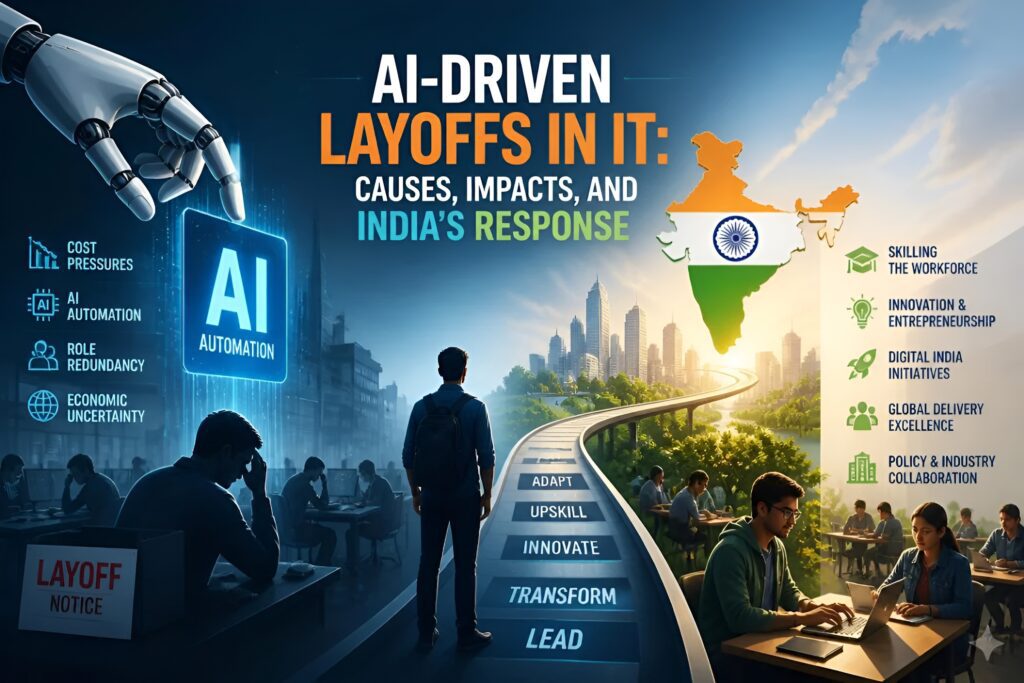
The Virtual Round Table organized by the Indian Council for Technical Research and Development (ICTRD) brought together industry leaders, academicians, technology experts, and professionals to discuss one of the most significant workforce transformations of the modern era, the growing impact of Artificial Intelligence on employment, industries, and India’s future readiness.
At a time when AI is rapidly reshaping global economies, business structures, and workforce dynamics, the discussion highlighted that India stands at a critical stage where adaptability, innovation, and continuous learning will define long-term competitiveness and growth.
AI Transformation and the Future of Work
Opening the session, Siddharth Roy, Director of Communication, emphasized that Artificial Intelligence is no longer a futuristic concept but a present-day reality transforming industries, workforce structures, and business operations across the globe. He highlighted the importance of collaborative dialogue and policy-oriented discussions to help India prepare strategically for technological transformation.
Building on this perspective, Dr. Ketan Mohitkar, Member Secretary, stressed that the real challenge is not AI itself, but outdated employability. He emphasized that while AI can automate repetitive tasks, human qualities such as creativity, leadership, emotional intelligence, and critical thinking will continue to remain essential in the future economy.
A key theme throughout the discussion was the transition from manpower-driven systems to intelligence-driven ecosystems powered by automation, AI integration, and digital technologies. Experts observed that repetitive roles in coding, testing, documentation, and support services are increasingly being automated, while opportunities are growing across emerging technology domains such as Artificial Intelligence, Cybersecurity, Cloud Computing, Robotics, Semiconductor Technologies, and Quantum Computing.
India’s Position in the Global AI Landscape
The discussion highlighted that India faces both challenges and opportunities in the AI revolution. While traditional IT service models are experiencing pressure due to automation and efficiency-driven systems, India’s strong STEM talent pool, startup ecosystem, expanding digital infrastructure, and national initiatives position the country to emerge as a global AI and innovation hub.
Programs such as the India AI Mission, Digital India, AI compute infrastructure initiatives, and indigenous platforms like Bhashini and BharatGen were recognized as important steps toward strengthening India’s long-term AI capabilities and technological independence.
Participants emphasized that India now has the opportunity to move beyond being primarily a global back-end support center and transition toward becoming a leader in AI innovation, advanced technology development, and product-based ecosystems.
Perspectives from Participating Experts
The discussion was enriched by diverse perspectives from experts across industry and academia. Mr. Rajdeep Bhattacharya highlighted that the future belongs to individuals who can work intelligently with AI rather than resist it, emphasizing adaptability and AI integration as the real competitive advantage.
Dr. T. Nagendra Rao reflected on the long evolution of technology and stressed that continuous learning and skill upgradation are now essential for survival in a rapidly changing workforce environment. He emphasized that technological disruption should be viewed as an opportunity for transformation rather than fear.
Dr. Priya Dongare Jadhav focused on the importance of practical learning, industry-oriented education, certifications, and interdisciplinary collaboration in preparing future-ready students capable of working effectively with AI technologies.
Mr. Rajesh Subburaj Naidu highlighted the structural shift from workforce-driven business models to AI-driven productivity systems. He emphasized that future employability will depend not only on technical expertise, but also on critical thinking, creativity, communication, and emotional intelligence.
Mr. Deepak D. Sondankar stressed the importance of balancing technological advancement with workforce sustainability. He highlighted the significance of the India AI Mission and emphasized that continuous reskilling and workforce protection must remain central to India’s AI journey.
Mr. Sachin Parikh emphasized that India must move from AI consumption toward AI creation by developing indigenous AI systems, innovation-driven startups, and advanced technological ecosystems. He stressed that the future lies in human-AI collaboration rather than replacement.
Mr. Vijayanand explained that AI-driven layoffs are part of recurring technological transition cycles and should not be viewed only as job losses, but as opportunities for reinvention, reskilling, and participation in emerging sectors such as semiconductors, AI infrastructure, and quantum technologies.
Workforce, Skills, and Adaptability
Another major theme throughout the discussion was the changing nature of employability in the AI era. Experts agreed that future professionals will require not only technical expertise in AI, automation, cloud systems, and cybersecurity, but also adaptability, creativity, leadership, communication, and continuous learning abilities.
The importance of reskilling, upskilling, certifications, project-based learning, and stronger industry-academia collaboration was repeatedly emphasized. Participants highlighted that the future workforce will be defined not only by knowledge, but by the ability to continuously evolve alongside technology.
Challenges on the Path Ahead
While AI presents significant opportunities, the discussion also highlighted several challenges including workforce displacement in repetitive roles, skill gaps, rapid technological changes, curriculum-industry mismatch, and the growing need for stronger indigenous AI infrastructure and innovation ecosystems.
A recurring insight throughout the session was that the greatest challenge is not technology itself, but the speed at which industries, institutions, and individuals can adapt to change.
ICTRD and the Role of Collaborative Platforms
The Indian Council for Technical Research and Development (ICTRD) continues to play an important role in fostering collaborative discussions on emerging technological and workforce challenges. By bringing together stakeholders from academia, industry, policy, and innovation ecosystems, ICTRD promotes knowledge exchange, strategic dialogue, and future-focused thinking aimed at building a stronger and future-ready India.
The session concluded with the recognition that Artificial Intelligence is fundamentally reshaping industries, economies, and workforce systems worldwide. While AI-driven transformation may disrupt traditional employment structures, it is also creating entirely new opportunities across advanced technology sectors.
Participants agreed that India’s future success will depend on continuous skill transformation, innovation-led growth, strong industry-academia collaboration, indigenous AI capability development, and the ability of individuals and organizations to continuously learn, adapt, and evolve alongside technology.
Also Read: Union Budget 2026–27: Growth & Reform Insights from ICTRD Round Table



More Stories
Will ( AI ) Artificial intelligence Replace Jobs? What Tech Leaders and Employees Say About the Future
बच्चे को पीठ पर बांधकर ड्यूटी करती मां का वीडियो वायरल, लोग बोले- ‘आधुनिक झांसी की रानी’
Trump U-Turn: US to Buy Russian Diesel as Zelenskyy Calls Move a ‘Gift to Putin’