





For decades, the semiconductor industry has relied on Electronic Design Automation (EDA) tools to improve chip design efficiency. These tools automated critical tasks such as simulation, synthesis, verification, and testing, enabling engineers to create increasingly advanced semiconductor devices. The industry believed that optimizing each stage of the design process would naturally improve overall productivity. However, modern chip development has reached a point where traditional automation alone can no longer meet industry demands. Engineers now design processors containing billions of transistors while integrating artificial intelligence, high-performance computing, and advanced communication technologies into a single chip. As projects become larger and more sophisticated, teams spend more time coordinating tools, resolving workflow issues, and exchanging design information than performing actual engineering tasks. Experts now believe the future of chip development depends not only on faster software but also on smarter collaboration supported by artificial intelligence throughout the entire design lifecycle.
Traditional EDA tools operate through predefined workflows where engineers manually configure software, execute simulations, review results, and transfer outputs between multiple applications. This approach worked effectively when semiconductor designs remained relatively simple and toolchains contained fewer dependencies. Today, however, chip manufacturers must manage heterogeneous architectures, hardware-software co-design, advanced packaging technologies, and increasingly complex Printed Circuit Board (PCB) integration. Every design modification can affect multiple systems simultaneously, forcing engineering teams to repeat simulations, verify compatibility, and validate manufacturing readiness across numerous platforms. Engineers frequently spend valuable hours translating data formats, identifying inconsistencies, and coordinating activities between different teams instead of focusing on innovation. Industry experts argue that simply improving the speed of individual software tools cannot solve these broader workflow challenges.
Also read :Nagpur Rain Havoc: 461 People Rescued as NMC Responds to 37 Emergencies
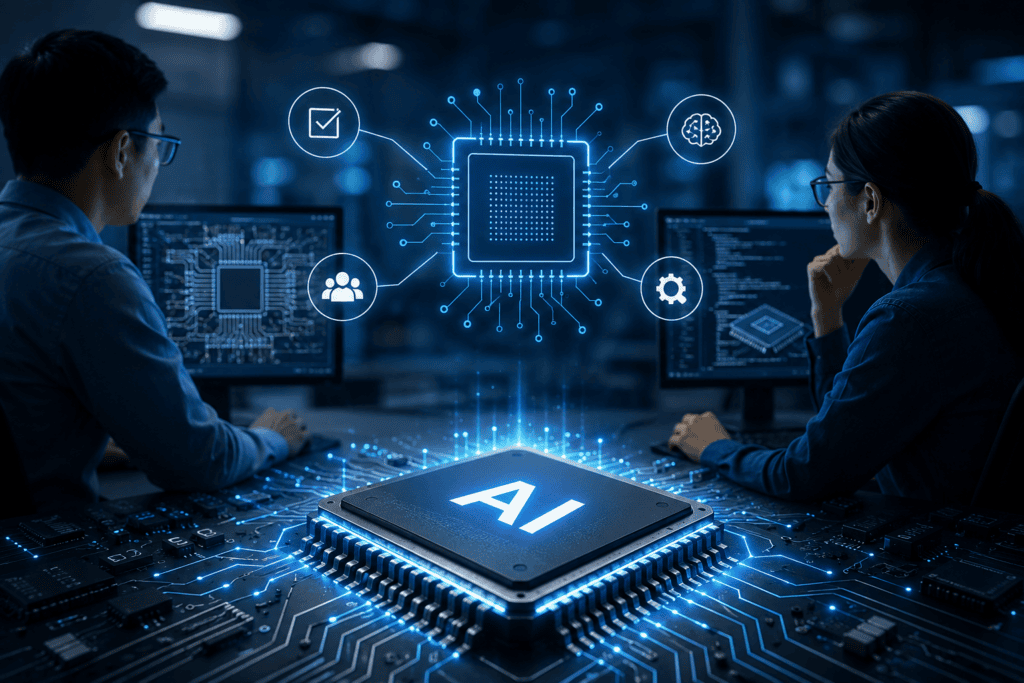
Semiconductor companies are adopting agentic AI to streamline chip design, reduce manual work, and accelerate product development
Artificial intelligence is emerging as the technology capable of transforming this fragmented workflow into a connected design ecosystem. Modern agentic AI systems move beyond executing predefined commands by understanding engineering intent, planning complex workflows, selecting appropriate software tools, and adapting automatically when design requirements change. For example, an engineer can describe a design modification using natural language, allowing an AI system to identify affected circuit blocks, launch simulations, analyze verification results, compare layout changes, and generate recommendations without requiring manual coordination. These intelligent systems also process information from waveforms, netlists, design logs, and verification reports to detect errors and recommend optimization strategies. Developers embed structured workflows, specialized parsers, and validation safeguards into these AI platforms to maintain engineering accuracy and production quality. This approach reduces repetitive manual work while enabling engineers to focus on solving technical challenges and accelerating product innovation.
The shift toward AI-powered collaboration also reflects the growing importance of interconnected software ecosystems within the semiconductor industry. No single EDA platform can support every phase of chip development, from architecture planning and logic design to verification, physical implementation, PCB layout, and manufacturing sign-off. Engineering teams therefore depend on software products from multiple vendors, each providing specialized capabilities. Although this diversity improves technical flexibility, it also creates communication gaps and workflow fragmentation. AI orchestration addresses these issues by connecting different software platforms, automatically transferring information, maintaining design consistency, and coordinating engineering tasks across departments. Instead of requiring engineers to manually synchronize dozens of applications, AI creates a unified intelligence layer that supports collaboration without replacing existing tools. This integrated approach improves productivity, minimizes costly errors, and shortens development timelines while preserving the specialized strengths of individual EDA platforms.
Semiconductor companies are adopting agentic AI to streamline chip design, reduce manual work, and accelerate product development
Industry leaders believe the transition from automation to collaboration will shape the next generation of semiconductor innovation. Future EDA platforms will not focus solely on executing faster simulations or producing quicker verification results. Instead, they will prioritize intelligent decision-making, workflow orchestration, and seamless collaboration between engineers, software systems, and manufacturing processes. As semiconductor companies develop increasingly sophisticated processors for artificial intelligence, automotive electronics, cloud computing, and consumer devices, they will require technologies capable of managing unprecedented design complexity. AI-powered orchestration offers a practical solution by connecting every stage of development into a coordinated and adaptive workflow. Experts expect these advancements to reduce engineering effort, improve product quality, accelerate time-to-market, and strengthen collaboration across global design teams. As AI capabilities continue to mature, collaborative intelligence will become a defining feature of the semiconductor industry’s future and a key driver of technological progress.
Also read :Lok Sabha Clears Anti-Paper Leak Bill by Voice Vote as Opposition Walks Out




More Stories
Will Trump’s Russia Oil Move Make Petrol and Diesel Cheaper in India?
1050 फीट गहरे बोरवेल में गिरा 9 साल का बच्चा, 39 घंटे बाद मौत
Prakash Raj Says India Is Neither Bangladesh Nor Nepal, Calls for Democratic Regime Change