




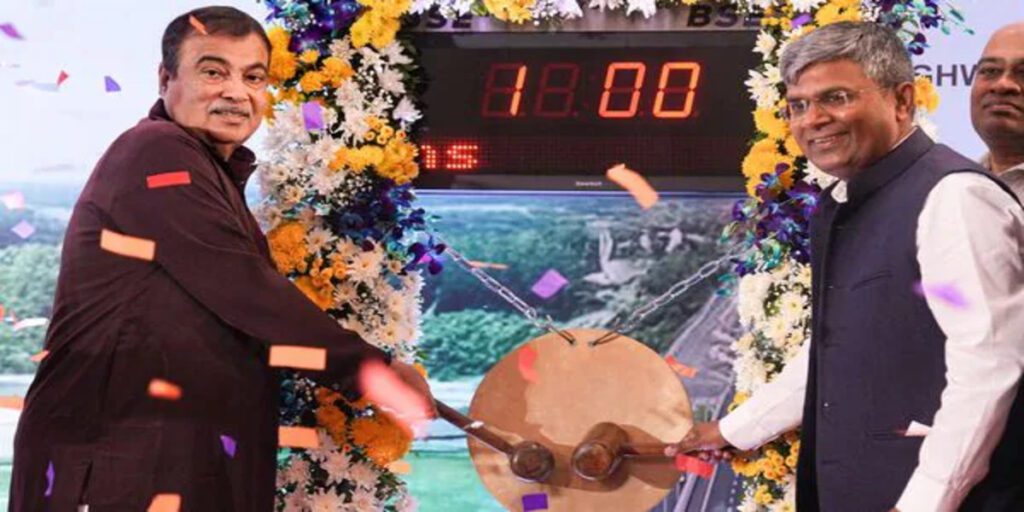
Union Road Transport and Highways Minister Nitin Gadkari said the new initiative will let everyday road users become stakeholders in national highway assets. On Tuesday, the National Highways Authority of India (NHAI’s) listed its first public infrastructure investment trust (InvIT) on the Bombay Stock Exchange. This step opens a new path for retail investors. It allows them to participate directly in National Highways Authority of India’s (NHAI’s) highway asset monetisation programme.
At the listing ceremony, Gadkari said road users can now own a share in the roads they use. He explained that this model can create a steady income stream. He also said it can improve wealth distribution across different income groups. According to him, the move will turn ordinary citizens into active partners in infrastructure development. He added that National Highways Authority of India’s (NHAI’s) initiative marks a major shift in how public assets connect with people.
Expanding NHAI’s Investment Access
Gadkari said the government wants to expand investment beyond large institutions. He pointed out that many road users come from lower and lower-middle-income groups. The government wants these groups to benefit from road development. This approach makes investment opportunities more inclusive and practical. It also bridges the gap between public assets and individual investors.
He compared this option with traditional savings tools. Bank deposits usually offer returns of 4–5%. In contrast, InvITs can offer better earning potential. They also provide a relatively stable income over time. This makes them attractive for small and first-time investors. Many people look for low-risk options with consistent returns. InvITs can meet that need in a structured way.
Gadkari also stressed the wider economic impact of this move. More participation can strengthen financial inclusion. It can also deepen trust in infrastructure projects. When citizens invest in national assets, they feel more connected to development. This sense of ownership can encourage long-term investment habits. At the same time, it reduces dependence on a limited group of large investors.
Also Read : Girls Lead the Way with 94.90 Percent Pass Rate, Surpassing Boys
Boost to Asset Monetisation Strategy
Earlier, NHAI allowed only institutional investors to invest in its InvITs. Now, retail investors can participate directly. This change marks a clear shift in policy direction. It reflects the government’s effort to widen the investment base. It also signals a more inclusive financial ecosystem.
NHAI has already raised over ₹1.42 lakh crore through different monetisation methods. These include toll-operate-transfer (TOT), InvITs, and securitisation. The government now aims to mobilise around ₹30,000 crore in the current financial year. These efforts will support ongoing and future infrastructure projects.
InvITs will play an important role in funding highway expansion. They provide a steady flow of capital for long-term projects. This move also aligns with the National Monetisation Plan. The plan focuses on unlocking value from existing assets. It then channels that value into new infrastructure development. This cycle helps maintain growth while reducing financial pressure on the government.
Also Read : PM Modi urges national unity amid escalating West Asia crisis



More Stories
Will Trump’s Russia Oil Move Make Petrol and Diesel Cheaper in India?
1050 फीट गहरे बोरवेल में गिरा 9 साल का बच्चा, 39 घंटे बाद मौत
Prakash Raj Says India Is Neither Bangladesh Nor Nepal, Calls for Democratic Regime Change