





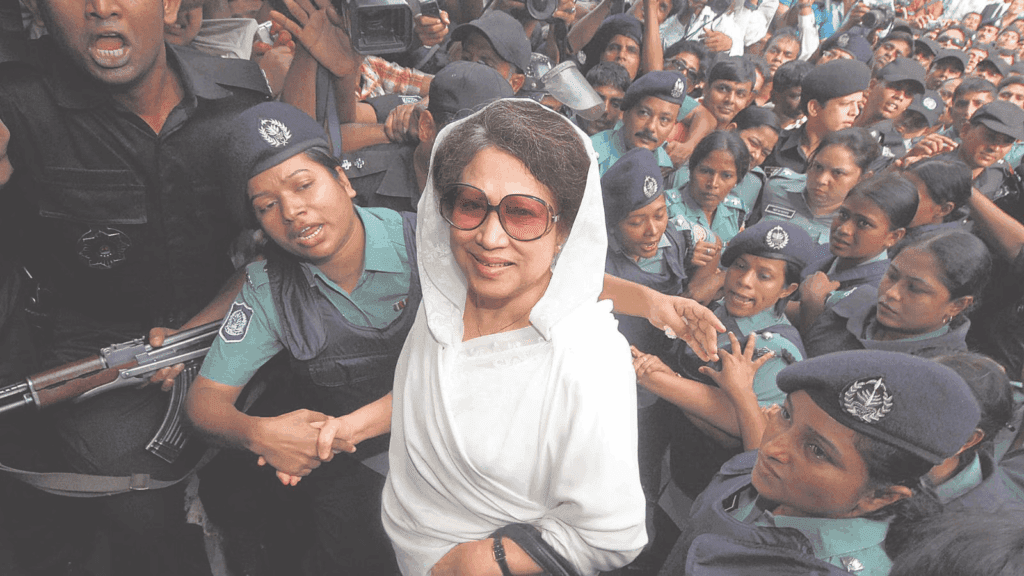
Khaleda Zia, Bangladesh’s first woman Prime Minister and longtime chairperson of the Bangladesh Nationalist Party (BNP), passed away at the age of 80 in Dhaka on December 30, just weeks before the country’s national elections scheduled for February 12.
According to the BNP, Khaleda Zia died at around 6 a.m. on Tuesday. The party confirmed her death through a Facebook post. She had been undergoing treatment at Evercare Hospital in Dhaka since November 23 after suffering from multiple health complications, including advanced liver cirrhosis, diabetes, arthritis, and heart and chest ailments.
Begum Khaleda Zia Death
Her death comes shortly after the return of her son, Tarique Rahman, who came back to Bangladesh on December 25 following 17 years in exile.
Also Read:Northwest Turkey Violence: 6 Islamic State Militants and 3 Police Officers Killed
Khaleda Zia as Prime Minister of Bangladesh
Khaleda Zia served as Bangladesh’s Prime Minister on three occasions — from 1991 to 1996, briefly in 1996, and again between 2001 and 2006. She assumed office for the first time after the fall of military rule, when the BNP won the February 1991 elections. During her initial term, her government reinstated the parliamentary system through the 12th Constitutional Amendment.
Education was a major priority during her first administration. Her government made primary education free and compulsory, extended free education for girls up to Class 10, and significantly increased funding for the education sector. Key economic initiatives were also launched, including the introduction of Value Added Tax (VAT), banking and financial reforms, and steps toward privatization. Bangladesh joined the General Agreement on Tariffs and Trade (GATT), established an export processing zone near Dhaka, and introduced administrative reforms such as direct mayoral elections and local government restructuring.
Her second term in 1996 was short-lived due to an election boycott that led to the establishment of a caretaker government system. The BNP subsequently lost power and moved into opposition.
Also Read:Supreme Court halts Kuldeep Sengar’s bail; convict will remain in custody
Ahead of the 2001 elections, the BNP formed a four-party alliance and secured a landslide victory, returning Zia to office for a third term. That administration focused on a 100-day reform agenda, boosting foreign investment, improving infrastructure, and sustaining economic growth.
Her tenure ended in October 2006 amid widespread political unrest related to the caretaker government issue, paving the way for a military-backed interim administration and elections in 2008. During this turbulent period, Bangladesh ranked among the world’s most corrupt countries in the Corruption Perceptions Index.



More Stories
कौन हैं मोजतबा ख़ामेनेई, जिन्हें अगल सुप्रीम लीडर माना जा रहा है
RSP Leads Nepal Election 2026
AIIMS जोधपुर से पढ़ाई, UPSC में टॉप कर बने मिसाल अनुज अग्निहोत्री