





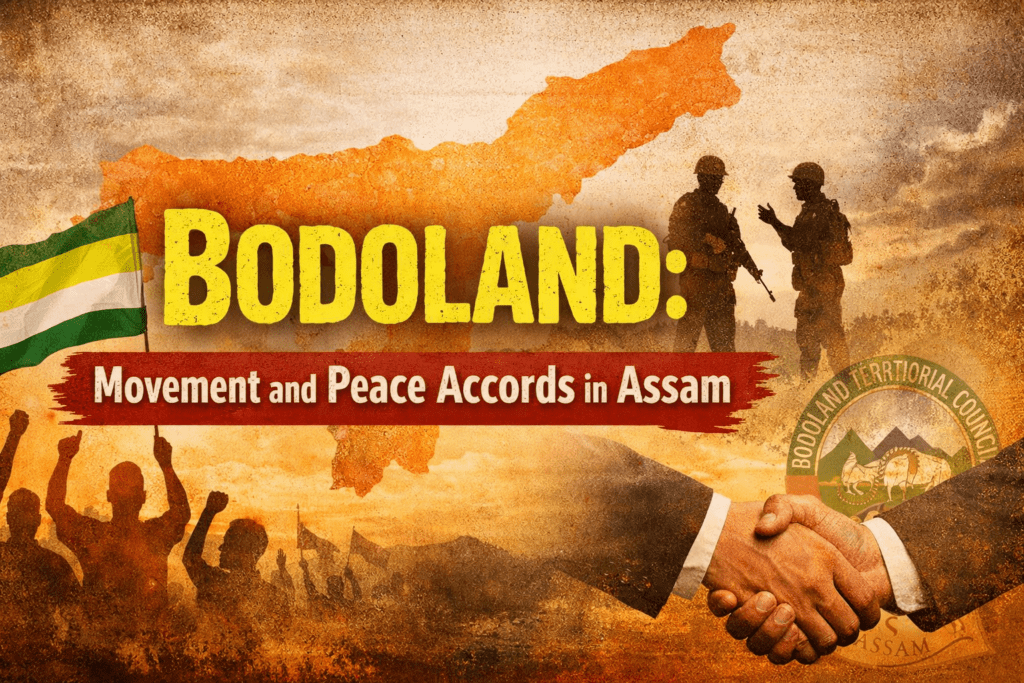
Bodoland has travelled a long path from protest and violence to political participation and regional autonomy. Today, preparations for Assembly elections continue across the Bodoland Territorial Region, a development that once seemed impossible during the peak of the movement.
The Bodos, who are the largest tribal community living in the plains of Assam, believed they did not receive enough political representation after independence. Their concerns increased further in 1960 when Assamese became the only official language of the state. Many Bodos viewed this decision as a direct threat to their language, identity, and cultural heritage.
The movement gained momentum through the efforts of the All Bodo Students’ Union, which was formed in 1967. Initially, the group focused on educational and social issues, but later it expanded its campaign to include demands for political autonomy and separate statehood under the leadership of Upendranath Brahma.
Also Read: Gold Surges After Trump Signals Iran Ceasefire
Bodoland Movement And Its Major Demands
Bodoland supporters demanded a separate state, which they called Udayachal or Bodoland. They also wanted Scheduled Tribe status, recognition of the Bodo language, and greater control over land and resources.
However, when these demands remained unresolved, frustration grew among many people. The movement gradually entered a violent phase, leading to clashes, killings, and displacement in several districts of Assam.
At the same time, the Assam Movement between 1979 and 1985 focused on illegal immigration. Even after the signing of the Assam Accord, many Bodos believed the agreement failed to address their concerns. Distrust increased further because of police action during protests and allegations of human rights violations.
As a result, militant groups such as the National Democratic Front of Bodoland and the Bodo Liberation Tigers emerged. While one group demanded a sovereign Bodoland, the other sought statehood within India.
Bodoland Peace Accords And Political Changes
The first major breakthrough came in 1993 with the creation of the Bodoland Autonomous Council. However, the agreement struggled because of unclear boundaries and weak administrative powers.
Later, the 2003 agreement established the Bodoland Territorial Council under the Sixth Schedule. This accord gave more autonomy to areas such as Kokrajhar, Chirang, Baksa, and Udalguri. After this agreement, many former militants joined mainstream politics and strengthened the Bodoland People’s Front.
The movement again made headlines after the 2008 serial blasts in Assam, which killed at least 80 people. Authorities blamed the National Democratic Front of Bodoland for the attacks.
Finally, the 2020 accord brought another major change. It included the All Bodo Students’ Union, NDFB factions, and the United Bodo People’s Organisation. The agreement expanded autonomy, introduced development packages, and created rehabilitation plans for former militants.
In 2023, the Assam government led by Himanta Biswa Sarma included more Bodo-majority villages in the Bodoland Territorial Region. The government also gave the Bodo language associate official language status in Assam.
Also Read: Mahesh Babu faces betrayal in Rajamouli’s leaked film plot




More Stories
मेरठ ब्लू ड्रम हत्याकांड: मुस्कान और साहिल को मृत्युदंड, सौरभ राजपूत की हत्या में कोर्ट का बड़ा फैसला
Meloni Calls US-Russia Diesel Deal a Risky Choice Amid Ukraine War
बिहार के राघोपुर में नाव पलटने से 13 बच्चों की मौत, स्थानीय लोगों ने क्या बताया?