





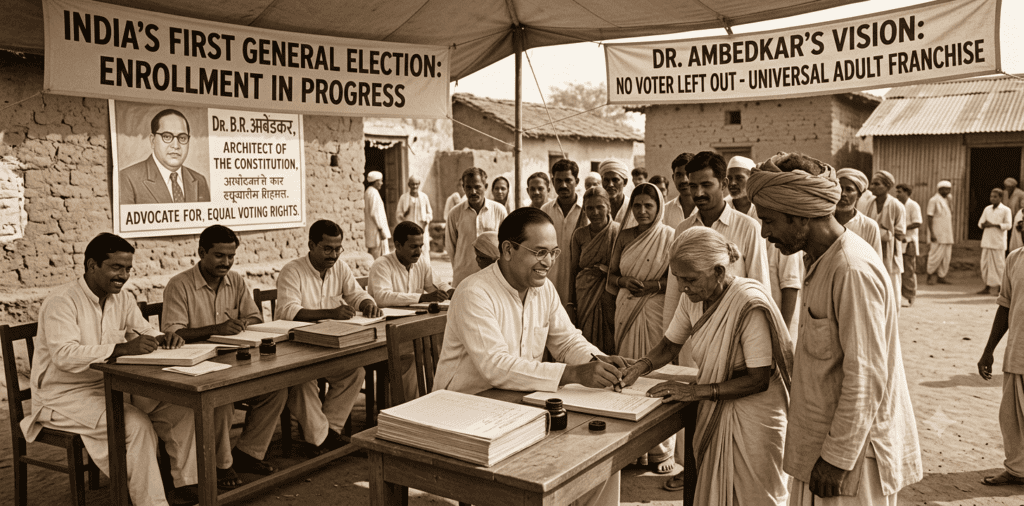
India began preparing its first electoral roll even before the country held its first general election in 1951. The Constituent Assembly Secretariat started the process in November 1947 and worked toward universal adult franchise. Around 16,500 clerks later helped type and organise the voter lists by constituency. Officials printed the rolls using nearly 380,000 reams of paper. Over four years, the exercise enrolled around 173 million voters despite the challenges created by Partition.
Also Read : Supreme Court Urges Delhi Police to Take Tough Action Amid Rising Rape Cases
From Limited Voting to Universal Adult Franchise
Under British rule, only a small section of Indians could vote because authorities linked voting rights to factors such as property, education and gender. The 1919 reforms allowed around seven million people to vote, while the 1935 Act expanded the electorate to more than 30 million. In 1947, the Constituent Assembly supported voting rights for every adult. Officials then began building an electoral system that could include millions of Indians, many of whom were illiterate.
The Secretariat issued detailed instructions in March 1948 for preparing the electoral rolls. It allowed citizens aged 21 and above to register, subject to specific eligibility conditions. Partition created a major challenge because millions of refugees had moved across borders and often could not meet the 180-day residence requirement. Officials eventually allowed migrants to register based on their declaration that they intended to settle permanently in India. This approach helped bring many displaced people into the electoral system.
Also Read : BJP Announces 8 Rajya Sabha Candidates, Hardeep Puri Dropped
A Massive Exercise That Shaped Indian Democracy
The process also faced concerns over exclusion and discrimination. Reports emerged that some officials in Assam were leaving certain groups, including Partition refugees, off the rolls. These developments strengthened the demand for an independent authority to oversee electoral registration. In June 1949, B R Ambedkar proposed a single central Election Commission to supervise voter-roll preparation and elections. He argued that officials should not exclude eligible voters because of local prejudice or personal discretion.
The Constituent Assembly accepted Ambedkar’s proposal, which later became Article 324 of the Constitution. Sukumar Sen became India’s first Chief Election Commissioner in March 1950 and took charge of the massive electoral exercise. The first roll eventually listed more than 173 million electors, while polling took place across thousands of polling stations from October 1951 to early 1952. The exercise demonstrated how India implemented universal adult franchise on an unprecedented scale. It also established the foundation for the country’s electoral system
Also Read : Supreme Court Urges Delhi Police to Take Tough Action Amid Rising Rape Cases


More Stories
Rahul Gandhi’s Convoy Cars Collide With Ambulance on UP Expressway
Jio Platforms IPO Sets Global Record With Over 1 Crore Applications
Maharashtra Man Chased, Run Over and Beaten to Death on Busy Road; CCTV Captures Brutal Murder