





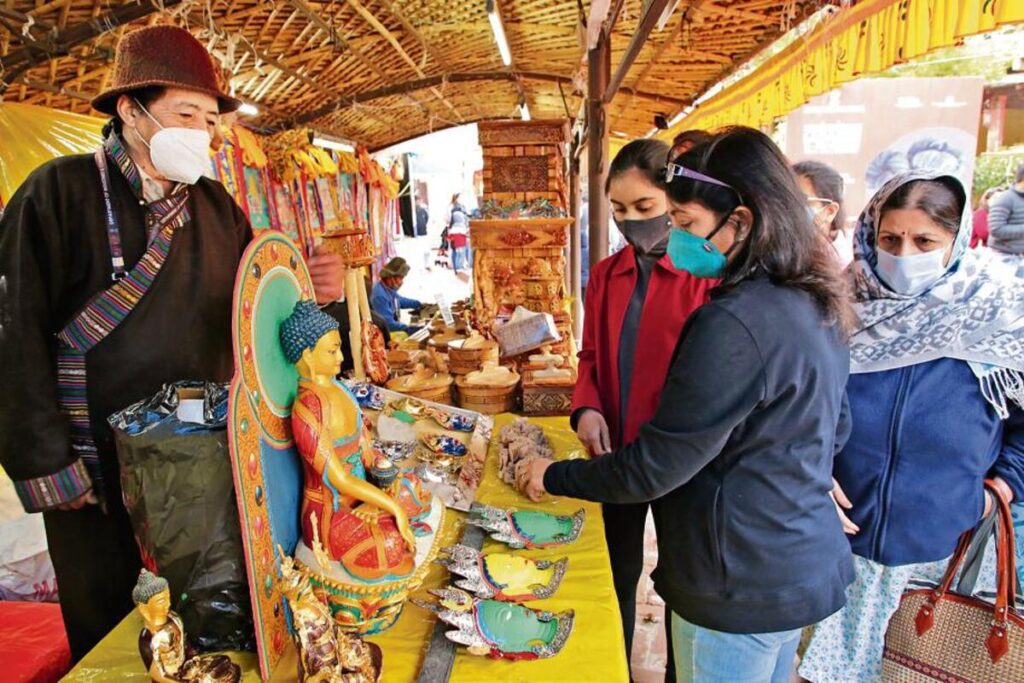
On Saturday, Delhi turned the spotlight on Ladakh’s changing textile landscape with the opening of Between Wind and Wool: Ladakh Design Today at the National Crafts Museum & Hastakala Academy. Curated by Sunil Sethi and supported by the FDCI team, the exhibition highlights how Ladakh’s harsh climate, deep-rooted heritage and nomadic traditions continue to influence pashmina craftsmanship and modern design expressions.
The exhibition was formally inaugurated by Ladakh Lieutenant Governor Kavinder Gupta, who attended as the chief guest. Meanwhile, Amrit Raj, Development Commissioner (Handicrafts) from the Ministry of Textiles, joined the event as guest of honour, underscoring the government’s support for regional craft traditions.
Tradition meets contemporary design
As visitors moved through the exhibition, they encountered a thoughtful blend of tradition and innovation. Designers reimagined classic pashmina forms while also weaving cultural narratives into the Sulma, the ceremonial robe traditionally worn by Ladakhi women. In this way, the showcase demonstrated how age-old techniques can evolve without losing their cultural essence.
The exhibition brought together four contemporary designers who are redefining Ladakh’s design identity today. These included Padma Yangchan of Namza Couture, Stanzin Palmo of Zilzom, Jigmat Norbu and Jigmat Wangmo of Jigmat Couture, and Padma Saldon of 2112 Saldon. Together, their work reflected both respect for heritage and a forward-looking design approach.
Also Read : Spain declares 3-day mourning after train crash
Ladakh as the true focal point
In addition to textiles, the exhibition featured a striking photography display that shifted attention away from conventional fashion imagery. Speaking about this element, curator Sunil Sethi explained that although models wore creations by designers from across India, the images deliberately avoided focusing on garments or faces.
Instead, as he noted, the real focus remained on Ladakh itself. The photographs highlighted the region’s dramatic mountains, snow-covered peaks and stark, desert-like terrain. Ultimately, the visual narrative reinforced the idea that the land and its environment remain the strongest influence behind Ladakh’s textile traditions.
Also Read : Greenland row pushes Europe to abandon its gentle handling of Trump




More Stories
AIIMS जोधपुर से पढ़ाई, UPSC में टॉप कर बने मिसाल अनुज अग्निहोत्री
IAF Fighter Jet Crash in Karbi Anglong Kills Two Pilots
Nitish Kumar’s Rajya Sabha Decision Triggers Unease In JD(U), Leaders Seek Review