





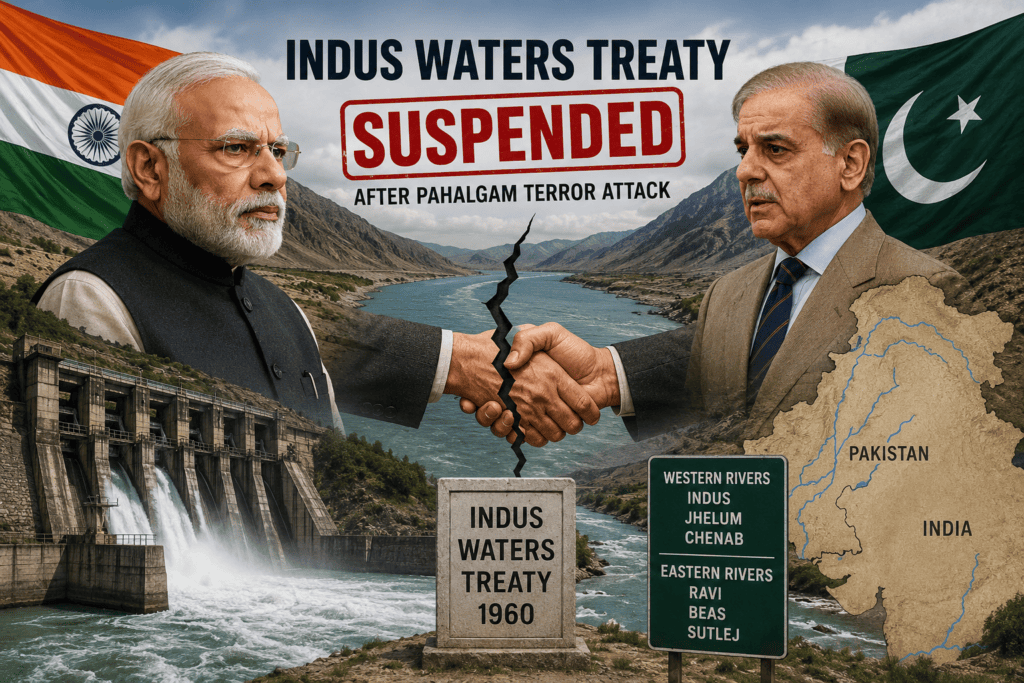
India’s decision to place the Indus Waters Treaty in abeyance after the April 2025 Pahalgam terror attack triggered a major international debate. While some global observers described the move as the weaponisation of water, international legal expert Dimitra Staikou argued that this view ignored the wider political and security context. According to her analysis, the treaty was not simply a legal water-sharing arrangement but a political agreement built on trust between India and Pakistan. India believes that repeated cross-border terrorism, prolonged hostility and continuing disputes gradually weakened that trust. The World Bank brokered the treaty in 1960, and India accepted several major restrictions despite being the upper-riparian state. The report argues that India made these concessions to support regional stability and maintain peaceful relations with Pakistan.
Also read: US Charges Indian Gang Leader Over Alleged Murder of Canadian Sikh Activist
Pakistan Received Major Share of Indus Basin Water Flow
According to the report, Pakistan received nearly 80 percent of the annual water flow of the Indus basin, amounting to around 135 million acre-feet from the western rivers. Pakistan was allocated the waters of the Indus, Jhelum and Chenab, while India retained rights over the eastern rivers Ravi, Beas and Sutlej. The analysis states that India did not receive additional water under the treaty and also contributed £62 million to support Pakistan’s downstream water infrastructure. That contribution is estimated to be worth around USD 2.5 billion today. Staikou argued that India continued to honour the treaty through wars, military tensions and terror attacks. However, Pakistan repeatedly challenged several Indian hydroelectric projects through the treaty’s dispute-resolution mechanisms, including Salal, Tulbul, Baglihar, Kishenganga, Ratle, Pakal Dul and Lower Kalnai.
The analysis places much of Pakistan’s growing water crisis on domestic governance failures rather than India’s actions. It says poor planning, weak investment and inadequate water management created serious pressure on Pakistan’s resources. World Bank assessments reportedly estimate that these shortcomings cost Pakistan nearly four percent of its GDP every year. Political disagreements have also delayed several important water-storage projects, resulting in nearly one-third of available river water flowing unused into the Arabian Sea. The report further notes that Pakistan reduced federal spending on the water sector for the 2026–27 financial year, which could weaken its already limited storage capacity. Pakistan’s agriculture depends heavily on the Indus river system, while the country reportedly has storage capacity for only around one month of river flow.
India Stops Sharing Flood Data and Speeds Up Hydropower Projects
India formally sought a review and modification of the treaty under Article XII(3) in January 2023 and again in August 2024. The report says Pakistan did not seriously engage with India’s concerns, leading New Delhi to suspend the treaty after the Pahalgam terror attack. India has stated that the treaty will remain in abeyance until Pakistan takes verifiable and irreversible action against cross-border terrorism. External Affairs Ministry spokesperson Randhir Jaiswal said Pakistan must credibly and permanently abandon support for terrorism. Indian officials argue that water agreements cannot operate separately from the security environment, especially when terrorism and hostile activities continue. India wants Pakistan to dismantle what it describes as terror infrastructure and end abnormal hostility before normal cooperation can resume.
Before the suspension, India shared flood-related information with Pakistan during the monsoon through the Indus Water Commissioners, but New Delhi is no longer required to provide such data. India has also accelerated several hydroelectric projects in the Indus basin, including Sawalkote, Ratle, Bursar, Pakal Dul, Kwar, Kiru and Kirthai projects. The report says these developments strengthen India’s strategic position and improve its ability to manage river resources. Pakistan has responded by increasing diplomatic outreach, contacting foreign envoys, sending delegations abroad, approaching the United Nations and pursuing legal action. It has also organised international conferences to gather support against India’s decision. The dispute has transformed a technical water-sharing treaty into a major strategic issue shaping India-Pakistan relations.
Also read: Gurgaon Heavy Rain Brings City to a Standstill as School Bus Sinks After Road Cave-In




More Stories
Climate Meets Technology: Advancing Innovation for a Sustainable Future
James Dyson Award 2026: Indian Student Designs Electric Vehicle for Security Patrols
बस हादसे के बाद खुली पोल, ग्रेटर नोएडा में 1.55 लाख का चालान और सुरक्षा इंतजामों की कमी