





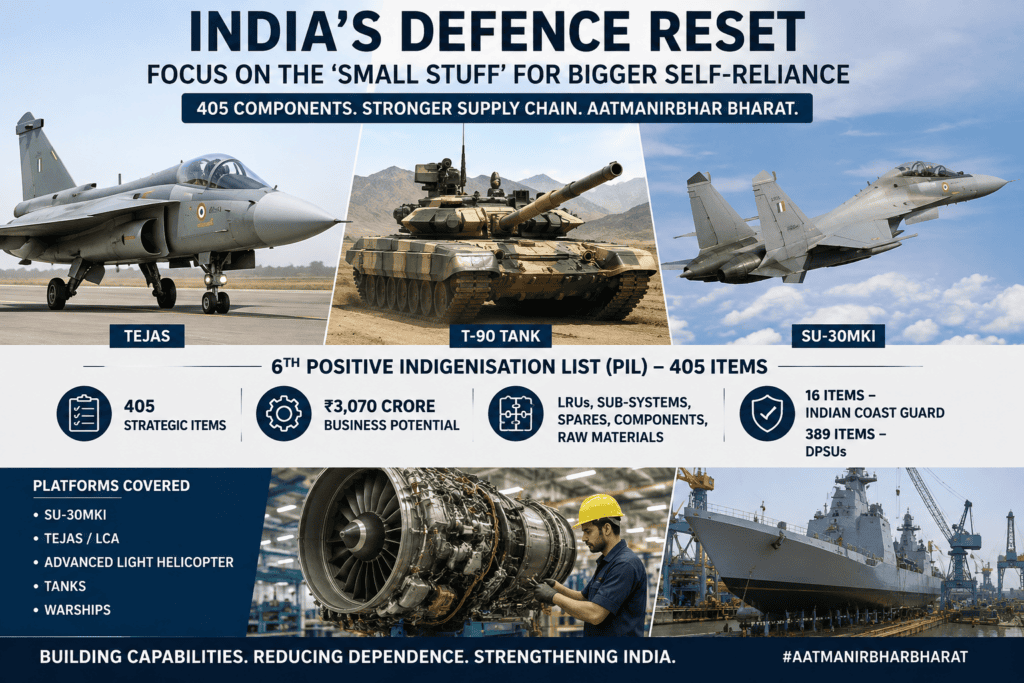
India is expanding its defence indigenisation strategy by focusing on the smaller components and subsystems that support major military platforms. Instead of concentrating only on large systems such as fighter jets, tanks, helicopters and warships, the latest initiative targets 405 strategically important items that can be manufactured within the country. The move is designed to reduce dependence on foreign suppliers and create a stronger domestic defence supply chain. The sixth Positive Indigenisation List includes items with an estimated business potential of around ₹3,070 crore. These include Line Replaceable Units, sub-systems, sub-assemblies, spares, components and raw materials. The initiative covers equipment linked to important platforms such as the Su-30MKI, Tejas/LCA, Advanced Light Helicopter, tanks and warships, marking another step toward greater self-reliance in defence production.
Focus Shifts From Big Platforms to Critical Parts and Subsystems
The latest list does not mean that India is immediately replacing every foreign-made part inside major defence platforms. Instead, the government is identifying specific components that can be produced domestically and gradually shifting their sourcing to Indian manufacturers. This approach can help reduce import dependence while also strengthening the availability of critical spares. For military platforms, even relatively small components can become important if their shortage affects maintenance or operational readiness. By developing domestic manufacturing capabilities for such parts, India can reduce the risks associated with overseas supply disruptions. The strategy also gives Indian companies an opportunity to participate in the defence supply chain and develop expertise in specialised manufacturing. Over time, these capabilities could support the larger goal of building a more independent and resilient defence ecosystem.
The sixth Positive Indigenisation List covers 405 items in total, with 16 items related to the Indian Coast Guard and 389 associated with Defence Public Sector Undertakings. The government has identified these items as strategically important for increasing domestic production. Their connection with platforms such as the Su-30MKI, Tejas, Advanced Light Helicopter, tanks and warships highlights the broad scope of the initiative. These platforms require thousands of individual components, spares and support systems to remain operational. Domestic production of selected items can therefore improve the availability of equipment and reduce the need to depend on imports for routine requirements. The estimated business potential of ₹3,070 crore also indicates that the initiative could create opportunities for Indian manufacturers, suppliers and smaller defence companies. It could encourage more private-sector participation in specialised defence manufacturing.
Also read :Top Bangladesh Intelligence Officials’ Pakistan Visit Raises Security Concerns in India
India Targets 405 Defence Components to Cut Import Dependence
The focus on smaller components also reflects a practical side of defence self-reliance. Building a complete fighter aircraft, tank or helicopter domestically requires years of technological development, large investments and extensive testing. Developing individual components and subsystems can provide a more gradual route toward deeper indigenous capability. Indian companies can gain experience by producing specific parts before moving into increasingly complex systems. This can strengthen domestic engineering, manufacturing and quality-control capabilities. It can also help develop a wider network of suppliers that can support major defence manufacturers. A stronger local supply chain could become particularly valuable during periods when international logistics face disruptions. The initiative therefore goes beyond simply replacing imported products; it aims to build industrial capacity that can support India’s defence requirements over the long term.
The latest indigenisation push should therefore be viewed as part of a broader defence manufacturing strategy rather than as an attempt to make the Su-30MKI, . The immediate objective is to increase domestic production of selected components, subsystems, spares and raw materials used across major platforms. If Indian manufacturers successfully develop reliable alternatives, the country can gradually reduce its dependence on overseas suppliers. At the same time, domestic production can create new business opportunities and strengthen the defence industrial base. The initiative shows that India’s self-reliance drive is increasingly moving beyond headline platforms and focusing on the . This approach could play an important role in creating a more secure and resilient defence supply chain.
Also read :Vijay Govt Seeks to Keep Students Away From CJP, Left Protests; Outfit Hits Back




More Stories
अलवर में मां ने दो बच्चों की हत्या कर की आत्महत्या, बचाने आई बहन घायल
Mona Agarwal, Avani Lekhara Win Gold and Silver for India at Asian Para Games
Economist Who Predicted 2008 Financial Crisis Warns India Must Accelerate Growth to Create Jobs