



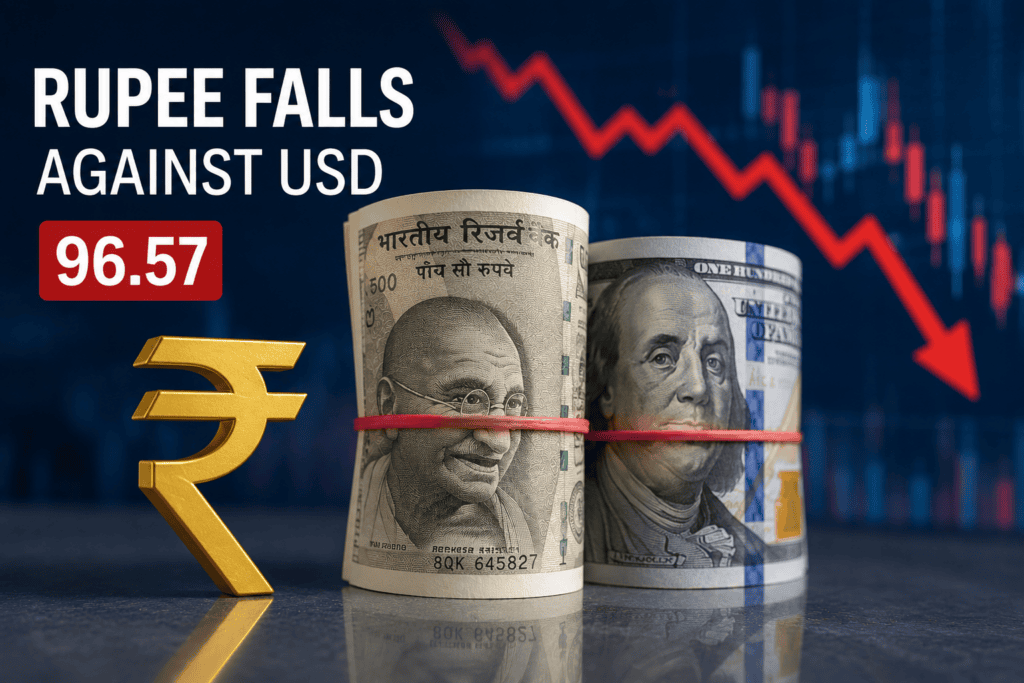
The Indian rupee weakened by 4 paise to close at 96.57 (provisional) against the U.S. dollar on Thursday, July 23, 2026. Forex traders attributed the decline to rising global crude oil prices driven by escalating tensions in West Asia. Since India imports a significant portion of its crude oil requirements, higher energy prices increased demand for the U.S. dollar and put pressure on the domestic currency. Throughout the trading session, the rupee remained under pressure as investors closely monitored global geopolitical developments and commodity price movements. However, market participants said likely intervention by the Reserve Bank of India (RBI) helped prevent a steeper fall and provided stability to the local currency during volatile trading.
Currency dealers said the rupee opened cautiously and traded within a limited range before ending the day slightly weaker. Persistent uncertainty in West Asia kept international crude oil prices elevated, raising concerns about higher import costs for India. A rise in oil prices generally widens the country’s import bill and increases demand for foreign currency, particularly the U.S. dollar. As a result, importers actively purchased dollars, adding further pressure on the rupee. Despite these challenges, forex traders observed signs of RBI support in the market, which helped reduce excessive volatility and reassured investors during the session.
Rising crude oil prices and escalating tensions in West Asia pushed the Indian rupee lower against the U.S. dollar.
Market experts explained that the Reserve Bank of India regularly monitors sharp fluctuations in the foreign exchange market to maintain financial stability. Whenever the domestic currency experiences unusual volatility, the central bank may intervene by supplying U.S. dollars from its foreign exchange reserves. Although the RBI does not officially disclose such operations immediately, traders often identify intervention through increased dollar availability in the market. Analysts believe this timely support prevented the rupee from weakening beyond the 96.57 level. They also noted that India’s healthy foreign exchange reserves continue to provide an important cushion against external economic shocks and global market uncertainty.
Apart from crude oil prices, investors also tracked the strength of the U.S. dollar and expectations surrounding future monetary policy decisions by the U.S. Federal Reserve. A stronger dollar typically affects emerging market currencies, including the Indian rupee, by attracting global capital toward U.S. assets. In addition, foreign institutional investor activity remained another important factor influencing currency movements. Any sustained outflow of foreign investments could further increase demand for dollars and weaken the rupee. Nevertheless, India’s steady economic growth and resilient financial system continue to support long-term confidence in the domestic currency.
Likely RBI intervention helped limit losses as the rupee settled at 96.57 against the U.S. dollar.
Looking ahead, market participants will closely monitor geopolitical developments in West Asia, global crude oil prices, and the Reserve Bank of India’s policy stance. Any easing of regional tensions could help stabilize oil prices and provide relief to the rupee in the coming weeks. Conversely, prolonged geopolitical uncertainty may keep energy prices elevated and continue to pressure import-dependent economies such as India. Currency analysts expect the rupee to remain sensitive to international events and investor sentiment. They advise businesses and investors to closely follow global economic indicators, crude oil trends, and central bank actions before making major financial or foreign exchange decisions.
Also read :PM Announces Fast-Track Courts for Paper Leak Cases Amid NEET Protest Row

More Stories
CJP आंदोलन पर हरीश साल्वे का बड़ा दावा, बोले- भारत में नेपाल और बांग्लादेश जैसे हालात बनाने की कोशिश
दिल्ली में विपक्ष के मार्च के बीच BJP का प्रदर्शन, कांग्रेस सांसद पर यौन शोषण का गंभीर आरोप, बांसुरी स्वराज ये बोलीं
राहुल के प्रदर्शन से पहले दिल्ली पुलिस अलर्ट, सुरक्षा के किए कड़े इंतजाम