





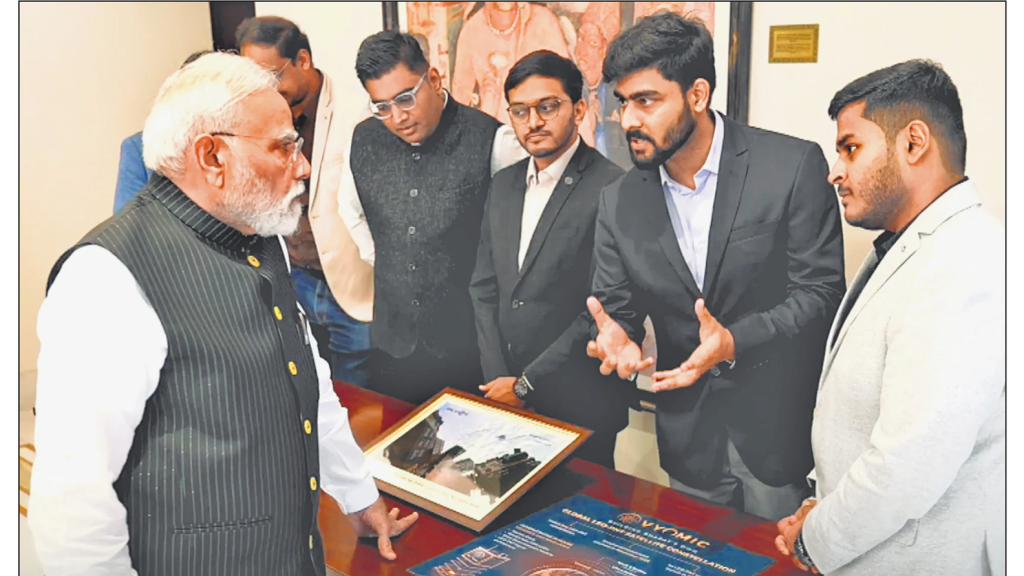
Prime Minister Narendra Modi said India can quickly establish itself as a major force in the global space sector, urging private space companies to build an ecosystem that attracts international talent, investment, and innovative businesses.
Modi made these remarks while interacting with chief executives and founders representing 20 private space companies, where he said India could become a global hub for space startups because domestic capabilities offer significant advantages. He highlighted India’s competitive launch costs, strong technical talent, and growing appetite for risk, saying these strengths could help the country rapidly strengthen its position in the global space industry. Modi urged entrepreneurs to create an environment where talented professionals worldwide choose India for building careers, saying, “We must create such an aura” that people want to join Indian startups and space organisations.
Also Read : Normal Petrol vs Power Petrol: Which Fuel Is Best for Turbocharged Cars
India’s Private Space Sector Gains Momentum with Investment and Innovation
He also highlighted government efforts to provide policy stability, confidence, and consistent support for ambitious entrepreneurs. Modi said entrepreneurs trusted government assurances and demonstrated courage by entering a rapidly developing strategic sector, while consistent government decisions could encourage investors and innovators to confidently accept greater risks. India opened its space sector to private participation in 2020, creating opportunities across satellites, launch systems, space applications, and other emerging industries.
The government said India had only one private space startup in 2014, compared with 440 today, while the Indian Space Policy 2023 further expanded private participation throughout the national space ecosystem. India currently holds roughly $9 billion of the estimated $600 billion global space industry, while the government aims to increase its share toward $40-45 billion during the next decade. Private investment also increased substantially, reaching approximately $618.5 million by March 2026, government figures showed. Companies including Skyroot Aerospace, Agnikul Cosmos, Pixxel, Dhruva Space, and GalaxEye presented ambitious plans involving satellite removal, orbital docking, refuelling, pharmaceutical manufacturing, and advanced robotic spacecraft for future missions. Skyroot Aerospace, which conducted India’s first private rocket launch in July, described the achievement as only the beginning and outlined plans to significantly increase launch frequency in the coming years.
Also Read : Vijay Celebrates World Photography Day by Stepping Behind the Lens




More Stories
Jio Platforms IPO Sets Global Record With Over 1 Crore Applications
Maharashtra Man Chased, Run Over and Beaten to Death on Busy Road; CCTV Captures Brutal Murder
Jio Platforms IPO में निवेशकों की भारी दिलचस्पी, तीसरे दिन सब्सक्रिप्शन 6 गुना के पार पहुंचा