


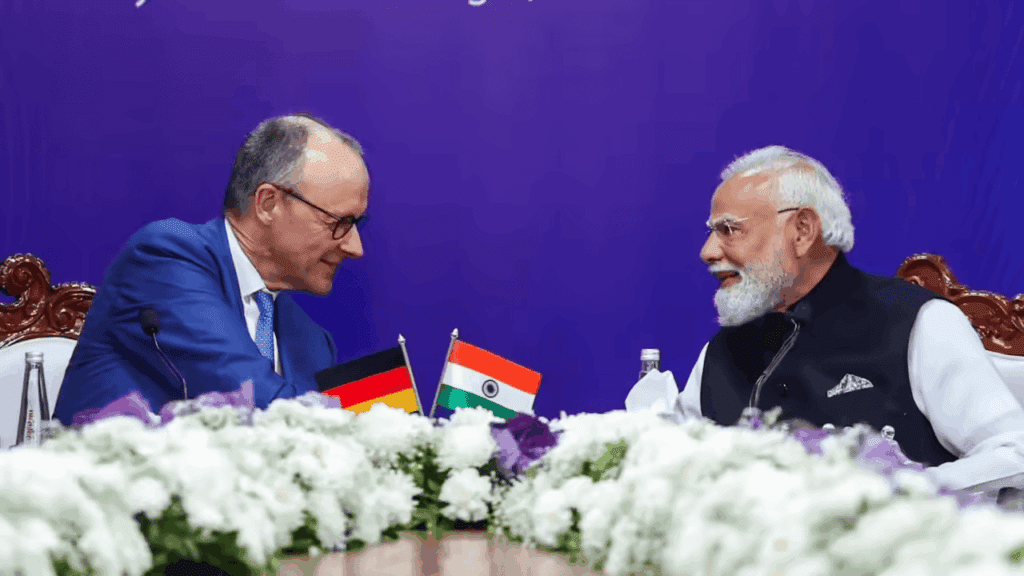
German Chancellor Friedrich Merz said on Monday that the European Union and India could sign a landmark free-trade agreement by the end of January, a step that could reshape global trade as protectionism increases and U.S.–India talks remain stalled.
Merz told reporters in Ahmedabad after meeting Prime Minister Narendra Modi that senior EU leaders would travel to India to finalise the agreement if negotiators complete the talks on time. He added that both sides would take another major step forward to bring the agreement into force.
Leaders aim to seal the pact as trade talks accelerate and U.S.–India negotiations remain stalled.
India and the EU have discussed the deal for years, and leaders on both sides see it as a way to strengthen economic ties and reduce dependence on China and Russia. In 2024, bilateral trade between India and the EU reached 120 billion euros, making the EU India’s largest trading partner.
Negotiators accelerated talks after the United States raised tariffs on Indian goods and urged India to reduce purchases of Russian oil. Meanwhile, India and the United States failed to conclude a separate trade agreement last year because the two governments lost momentum in negotiations.
The proposed EU–India pact would follow the EU’s recent agreement with South America’s Mercosur bloc and support Europe’s effort to build new trade partnerships as global trade rules evolve.
Indian Trade Minister Piyush Goyal said at a separate event in Gujarat that negotiators were close to finalising the agreement. German officials described Merz’s discussions with Modi as intensive and said they had increased hopes for a breakthrough.
Talks gain momentum as both sides push to strengthen ties and counter rising global protectionism.
The EU is pressing India to cut tariffs on cars, medical devices, wine, spirits and meat, and to strengthen intellectual-property protections. India, in turn, is seeking duty-free access for labour-intensive goods and quicker recognition of its auto and electronics industries. Officials say disputes over steel, carbon taxes and market access still require compromise.
During the visit, Germany and India signed agreements covering minerals, healthcare and artificial intelligence.
Merz also urged India to reduce its reliance on Russian energy and defence supplies, while acknowledging that India still depends heavily on Russian oil, gas and military equipment. He said both countries shared the same assessment of Russia’s war against Ukraine, but recognised India’s practical constraints.
Merz chose India for his first Asian visit as chancellor, signalling a shift in Europe’s strategic focus away from China alone. He warned that the world is entering a new phase of damaging protectionism that hurts both Germany and India.
He also noted that U.S. tariffs and Chinese export controls on key minerals and semiconductors have disrupted global supply chains and affected industries such as German car manufacturing.
Read Also:Indian shares fall for a fourth straight day as global uncertainties grow
Indian stock markets extended their losses for a fourth straight session on Thursday as foreign investors continued to sell equities and global uncertainty weakened investor sentiment. The Sensex fell 780 points, or 0.92%, to close at 84,180.96, while the Nifty 50 dropped 264 points, or 1%, to settle at 26,140.75.
Heavy selling by foreign institutional investors, pressure on the rupee, and uncertainty over global monetary policy pushed the Sensex below the 85,000 mark and dragged the Nifty close to 26,100, signalling growing technical weakness.
On Friday, markets opened cautiously, with GIFT Nifty pointing to a mildly positive start near 26,000. However, sentiment stayed fragile after the Nifty lost about 3,200 points from its December peak. The Sensex confirmed its weak trend by slipping below the key 85,000 level.
Analysts now see immediate support for the Sensex around 83,600–83,700, while the Nifty needs to climb above the 26,400–26,500 zone to regain strength.
Read Also:Will Smith considers Bollywood debut alongside Shah Rukh Khan
Oscar-winning actor Will Smith said in Dubai that he wants to collaborate with Shah Rukh Khan in a Bollywood film. While attending the premiere of National Geographic’s Pole to Pole, Smith told Gulf News that he had earlier discussed possible projects with Salman Khan and Amitabh Bachchan, but none of those plans moved forward.
Smith said he had spoken with Salman about several ideas and also held conversations with Amitabh Bachchan. He recalled that Bachchan jokingly suggested calling him “Big W,” which led to a light-hearted exchange between them. Smith added that although they explored a few concepts over the years, none of the projects eventually took shape.


More Stories
कौन हैं मोजतबा ख़ामेनेई, जिन्हें अगल सुप्रीम लीडर माना जा रहा है
RSP Leads Nepal Election 2026
AIIMS जोधपुर से पढ़ाई, UPSC में टॉप कर बने मिसाल अनुज अग्निहोत्री