





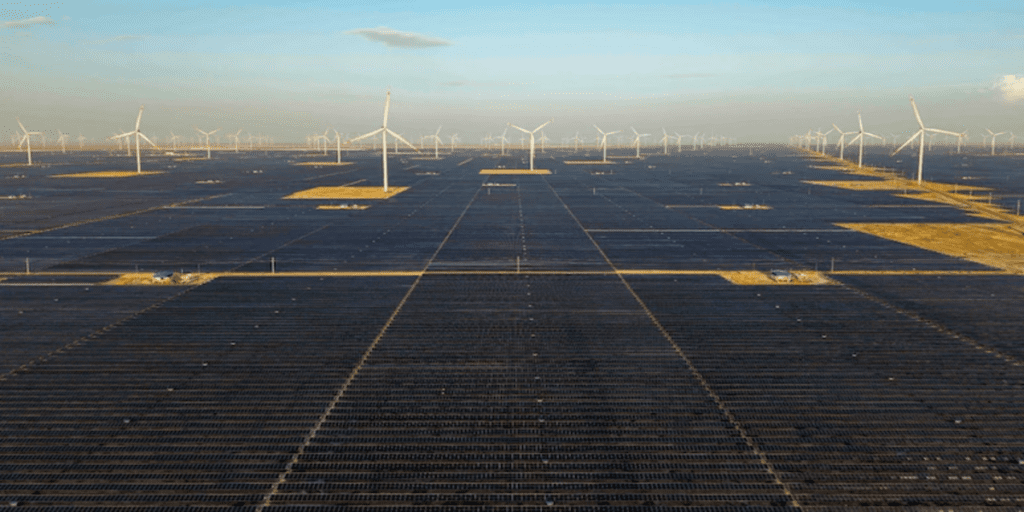
Adani Green Energy Limited (AGEL) announced on Wednesday that it added more than 5 GW (5,051 MW) of renewable energy capacity during the financial year 2025–26, increasing its total operational capacity to 19.3 GW.This marks the largest greenfield annual capacity expansion by any company globally, excluding China.The newly added capacity comprises 3.4 GW (3,409 MW) of solar power, 0.7 GW (686 MW) of wind energy, and 1 GW (956 MW) of hybrid wind-solar projects.
Adani Green Energy Limited Drives Major Carbon Cut
The company expects this expansion to offset nearly 10 million tonnes of carbon emissions annually. With a total operational capacity of 19.3 GW, AGEL will generate an annual carbon offset of 36 million tonnes, reinforcing its position as India’s largest pure-play renewable energy firm. Sagar Adani, Executive Director of AGEL, described the achievement as a landmark moment for India’s renewable energy sector. He said the addition significantly boosts the country’s transition toward a low-carbon economy while enhancing energy security. He further added that the milestone brings the company closer to its goal of reaching 50 GW capacity by 2030, while continuing to promote sustainable and inclusive growth through renewable energy and storage solutions.
Also Read:William Walsh appointed IndiGo CEO after Elbers’ exit
Khavda Mega Project Powers AGEL’s Renewable Expansion
AGEL has developed a major portion of this new capacity at the Khavda site in Gujarat, where it is building the world’s largest renewable energy plant. Spread across 538 square kilometres—about five times the size of Paris—the project aims to reach 30 GW capacity by 2029. So far, 9.4 GW (9,413 MW) has already been installed at the location. In addition, the company has commissioned an initial 1,376 MWh of battery energy storage systems (BESS) at Khavda, making it one of the largest single-location deployments globally. The company achieved this within just eight months of starting construction and expects it to improve grid stability and support renewable energy integration.
The project uses advanced bifacial solar panels that generate power from both sides by capturing direct sunlight as well as reflected light from the ground. It also incorporates solar trackers to optimize energy generation. AGEL has deployed high-capacity 5.2 MW wind turbines—among the most powerful onshore units worldwide. Additionally, the use of waterless robotic cleaning systems ensures minimal water consumption while enhancing operational efficiency.
Also Read:Global Nuclear Arms Race Intensifies




More Stories
Jio Platforms IPO Sets Global Record With Over 1 Crore Applications
Maharashtra Man Chased, Run Over and Beaten to Death on Busy Road; CCTV Captures Brutal Murder
Jio Platforms IPO में निवेशकों की भारी दिलचस्पी, तीसरे दिन सब्सक्रिप्शन 6 गुना के पार पहुंचा