




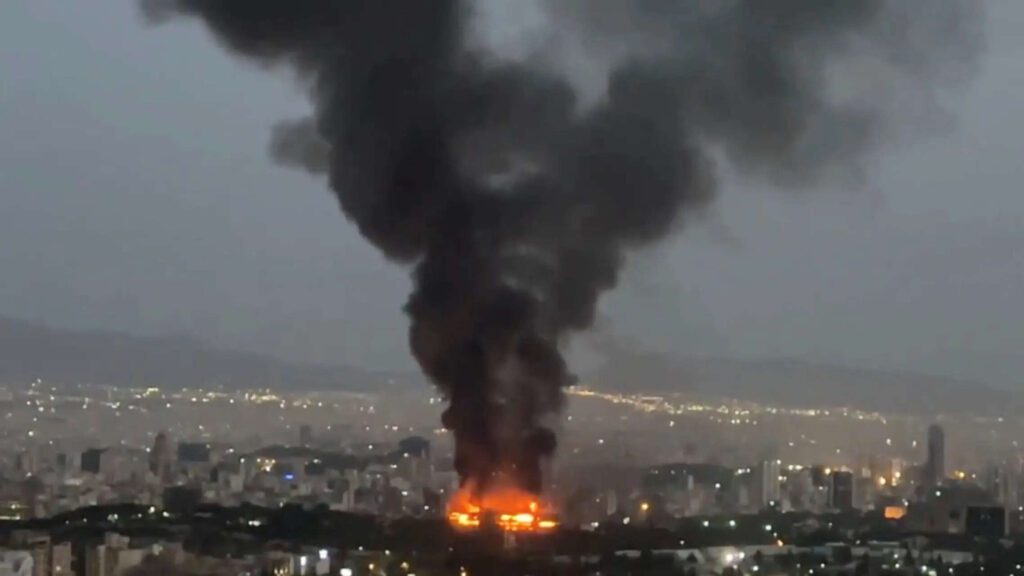
Residents in Tehran say the ongoing Tehran War has turned their city into a place of fear, destruction and economic uncertainty. Continuous airstrikes by the United States and Israel have heavily affected Iran’s capital, a densely populated city with nearly 10 million people.
A woman named Hoda said she once supported attacks against Iran’s security forces after the government’s violent crackdown on protesters earlier this year. However, her views changed when bombs began falling near her home in Tehran. She now regrets supporting the attacks and says the strikes are destroying the country.
Tehran War leaves residents fearful as airstrikes damage homes and disrupt daily life.
Residents say strikes on oil facilities have created an unusual and frightening environment in the city. Thick smoke often fills the air, and some people report black, oily rain falling onto streets and cars. Many people now avoid going outside, especially since heavy traffic already made traveling across the city difficult even before the war.
The war has also created serious economic problems. Hoda runs a business that imports carpet-weaving machines, but her business has suffered major losses over the past year. Banks now operate for limited hours, and ATMs allow only small withdrawals. Residents say prices for basic goods have already increased by around 10 percent since the war began.
Hadi also lost his tourism business after months of protests, internet shutdowns and the war. His daughter and ex-wife recently moved to northern Iran near the Caspian Sea, where many Tehran residents have temporarily relocated to escape the conflict. Hadi worries about his daughter’s education because she has already missed more than 100 days of school this year.
Also Read : India receives first oil shipment through Strait of Hormuz amid Iran-US war
Meanwhile, residents spend much of their time watching international news channels or using VPN services to access information online because of internet restrictions. Another resident, Kianoosh, a documentary filmmaker, said explosions occur almost constantly near his neighborhood in central Tehran. He recently moved in with his parents to ensure their safety. While power cuts have happened occasionally, he says the city has not yet faced the severe electricity and water shortages that affected Tehran last year.
Despite the conflict, daily life continues in some parts of the city. Markets still sell fresh produce, and cafés remain open. Amin, a café owner in Tehran, says his business is currently busy because people gather there at night during Ramadan to discuss the war and spend time with friends.
However, Amin remains worried about the future. He fears that if the war continues for a long time, ordinary people and small businesses will face serious financial difficulties. Many residents now wonder what the future holds for Iran. Some fear that even if the fighting stops, the country could remain politically and economically unstable for years.


More Stories
Education Reform Likely as BMC Introduces PPP Model in Schools
इनकम टैक्स में 7 बड़े बदलाव 1 अप्रैल से लागू, जानें असर
LPG Supply Crunch in Hyderabad Shrinks Restaurant Menus