




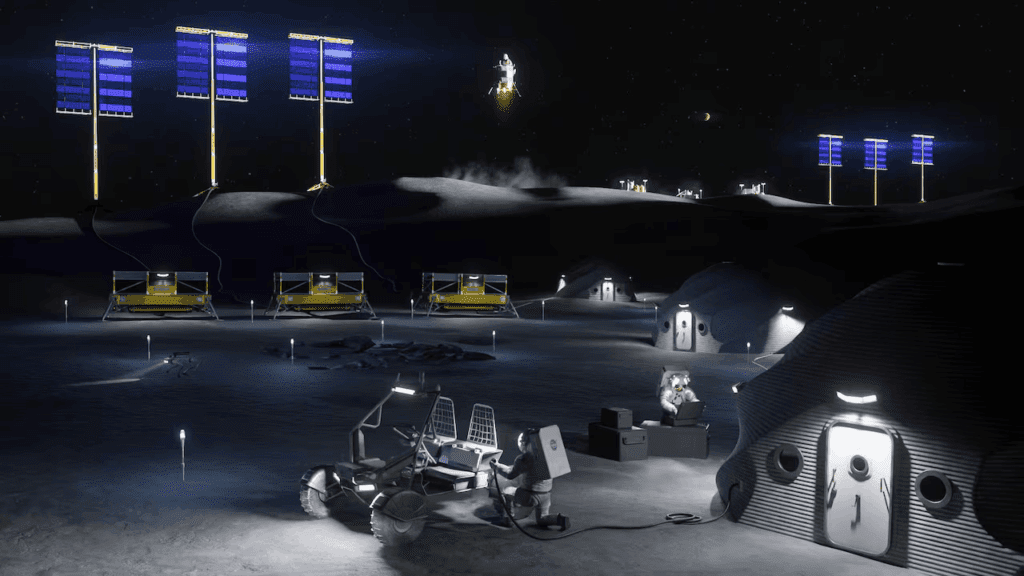
NASA has revealed new details about robotic landers, hopping drones, and lunar vehicles that will support America’s plan to build a permanent base on the Moon. Several private companies, including Blue Origin, have received contracts to develop these advanced machines. The United States aims to send astronauts back to the Moon before President Donald Trump leaves office in 2029. The mission is part of a larger effort to strengthen America’s presence in space. NASA officials believe these technologies will prepare the way for long-term human settlement on the lunar surface.
The renewed Moon mission has intensified competition between the United States and China in the growing global space race. China plans to land astronauts on the Moon by 2030 and continues to expand its space programme rapidly. Earlier this week, China launched the Shenzhou-23 spacecraft carrying astronauts to the Tiangong Space Station. NASA recently announced a massive $20 billion Moon base programme focused on the lunar south pole. The agency hopes the project will help the US maintain leadership in space exploration and scientific research.
NASA’s Moon Base programme will move forward in three major phases over the next several years. During the first phase, robotic landers and hopping drones will explore and map the Moon’s difficult terrain before astronauts arrive. Delivery vehicles and rovers will transport scientific instruments, communication systems, and equipment across the lunar surface. Companies such as Intuitive Machines and Astrobotic are building some of the key technologies for these missions. NASA expects around 25 launches and several tonnes of cargo to reach the Moon before 2029. The robotic missions will also test autonomous navigation and precision landing systems.
Also Read: CM Vijay’s Delhi Visit: PM Modi, Rahul Gandhi Meetings Planned
NASA advances Moon base mission
One of the major projects includes Blue Origin’s lunar lander called Endurance, which NASA wants to use for accurate autonomous landings on the Moon. Astrobotic’s Griffin-1 is expected to land near the Moon’s south pole at Nobile Crater. The missions will carry advanced scientific tools, including high-resolution cameras and laser-based landing systems. These instruments will help scientists study the Moon’s environment and improve future lunar missions. NASA believes robotic exploration will reduce risks before humans begin living on the Moon.
The next stage of the programme focuses on building power systems and semi-permanent housing for astronauts. NASA plans to establish nuclear and solar energy facilities, including small fission reactors, to support long-term operations. Astronauts would eventually use advanced rovers to travel across large areas of the Moon’s rocky surface. Scientists are especially interested in the lunar south pole because frozen water deposits there could provide drinking water and oxygen. The Moon base could also help future missions travel more easily to Mars. NASA hopes humans will begin living on the Moon by 2032.
Despite these ambitious goals, many experts believe NASA faces serious technical and political challenges. The agency still depends heavily on SpaceX to develop the Starship Human Landing System capable of safely carrying astronauts to the Moon. However, repeated delays and testing problems have slowed progress. Some scientists believe China could become the next nation to land humans on the Moon before the United States. Experts say NASA’s current timeline may be difficult to achieve without major technological breakthroughs. Still, the agency continues pushing forward with plans to create a lasting human presence beyond Earth.



More Stories
Will Trump’s Russia Oil Move Make Petrol and Diesel Cheaper in India?
1050 फीट गहरे बोरवेल में गिरा 9 साल का बच्चा, 39 घंटे बाद मौत
Prakash Raj Says India Is Neither Bangladesh Nor Nepal, Calls for Democratic Regime Change