


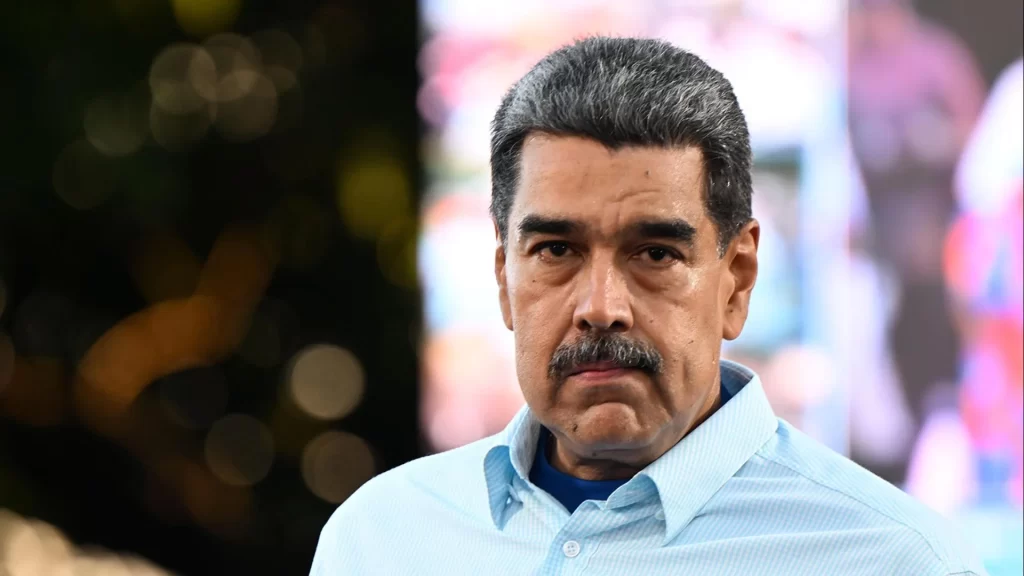
As US special operations forces finalized plans for a covert nighttime raid in central Caracas, Venezuelan President Nicolás Maduro hosted China’s senior envoy for Latin America at the presidential palace, publicly praising Beijing’s leadership and ties with his country.
Maduro thanked Chinese President Xi Jinping for what he called enduring “brotherhood,” likening Xi to an elder sibling during a lighthearted exchange with diplomat Qiu Xiaoqi at Miraflores Palace. Hours later, elite US Army Delta Force commandos stormed Maduro’s residence and captured him, stunning Beijing and abruptly depriving China of one of its closest allies in Latin America.
Also Read: The Supreme Court has refused to grant bail to Umar Khalid and Sharjeel Imam
Online speculation in China contrasts with official caution as Beijing weighs implications for Taiwan
China and Venezuela have shared deep political and economic ties for decades, driven by ideological alignment and a shared opposition to US global dominance. In 2023, the two countries further strengthened those ties by forming an “all-weather strategic partnership,” which expanded Chinese financial assistance and diplomatic support.
China has long served as Venezuela’s largest oil customer, and Chinese companies have poured investments into infrastructure and development projects across the country. Over the years, Beijing has lent Caracas billions of dollars. Maduro’s ouster now threatens China’s preferential access to Venezuelan crude and raises broader questions about Beijing’s political and economic influence in the region following Washington’s intervention.
Chinese officials quickly condemned the operation, accusing the United States of acting as a global enforcer. At the same time, the incident sparked intense debate on Chinese social media, where users openly speculated about its broader implications.
“If the US can capture a foreign leader in its own hemisphere,” some commenters asked, “why can’t China do the same elsewhere?” By late Monday, discussions related to Maduro’s capture had attracted more than 650 million views on Weibo, with nationalist voices arguing that the raid offered a potential template for a future Chinese operation against Taiwan.
China claims the self-governing island as its territory and has repeatedly vowed to bring it under its control by force if necessary. In recent years, Beijing has stepped up military pressure on Taiwan, including large-scale exercises that simulate blockades.
Despite the online fervor, Chinese officials adopted a far more restrained tone. Beijing described the US action as a “hegemonic violation,” demanded Maduro’s release, and stressed the importance of respecting national sovereignty.
President Xi Jinping indirectly rebuked Washington during talks with Ireland’s prime minister, warning that “unilateral bullying” undermines the international order and urging major powers to uphold international law.
State media outlets echoed that criticism, portraying the raid as proof of American hypocrisy. A Xinhua commentary argued that Washington’s so-called “rules-based international order” serves US interests rather than universal principles.
Meanwhile, a social media account linked to the People’s Liberation Army emphasized the importance of military strength, warning that weak capabilities invite external aggression.
China’s response stood in sharp contrast to its position on Russia’s invasion of Ukraine in 2022, when Beijing avoided condemning Moscow and instead blamed the conflict on US and NATO provocation.
The US raid upends Beijing’s regional strategy even as Chinese nationalists draw lessons for Taiwan
From an economic standpoint, analysts say the raid is unlikely to significantly disrupt China’s energy supply. Venezuela’s oil output has declined sharply over the past decade, and smaller independent refiners in China purchase much of the crude because of steep discounts.
The US raid has disrupted Beijing’s regional strategy even as Chinese nationalists draw lessons for Taiwan.
Although Washington may allow China to continue importing Venezuelan oil at lower volumes, any new arrangement would likely eliminate the discounts that previously made the crude attractive to Chinese buyers.
Beyond energy, China has treated Venezuela as a major investment destination. Since 2007, Beijing has lent the country more than $60 billion, making Venezuela China’s largest single borrower worldwide.
In Taiwan, officials rejected comparisons between Venezuela and the island’s situation. Lawmaker Wang Ting-yu said China lacks the practical capability to carry out a similar operation and described such comparisons as inappropriate.
Analysts broadly agree that the US action will not fundamentally change Beijing’s calculations on Taiwan. Instead, China’s decisions will continue to hinge on domestic economic conditions, military readiness, Taiwan’s internal politics, and US policy toward both Taiwan and China.
Even so, experts warn that Washington’s move could normalize the use of military force to achieve foreign policy goals, underscoring the need for Taiwan to strengthen its defenses and deterrence.
Across Latin America, China now faces a strategic setback but is likely to prioritize protecting its economic interests rather than escalating direct confrontation with the United States. Beijing will rely heavily on its investments in infrastructure, energy, and telecommunications to preserve its regional influence.


More Stories
खामेनेई की मौत के बाद भारत क्यों साधे हुए है चुप्पी
कैच: अक्षर पटेल-शिवम दुबे की शानदार जुगलबंदी, गंभीर का रिएक्शन वायरल
“कुर्द हमारी लड़ाई नहीं लड़ेंगे”: इराक की फर्स्ट लेडी की बड़ी अपील