



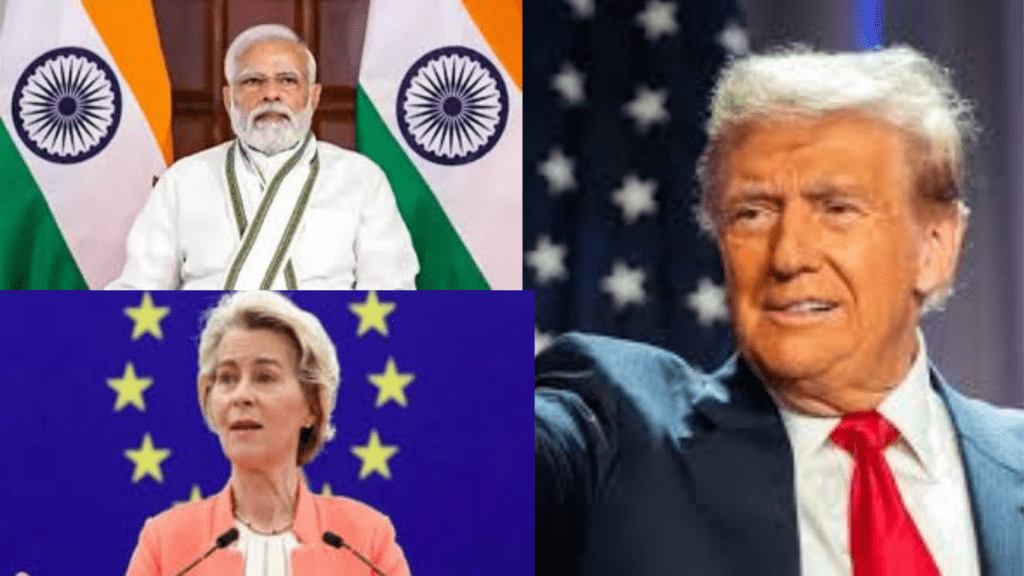
A sweeping realignment of global trade and diplomacy is underway, driven by mounting uncertainty over US protectionist policies under President Donald Trump. At the centre of this shift stands the newly signed India– EU Free Trade Agreement, widely described as the “mother of all deals” for its sheer economic scale and strategic impact.
Signed on January 27, the landmark pact brings together a combined market of nearly two billion people and accounts for almost a quarter of global GDP. Prime Minister Narendra Modi called the agreement a “perfect example of a partnership between two major economies”, while European Commission President Ursula von der Leyen said the deal had “made history”.
The India-EU agreement has emerged as a template for countries seeking to de-risk trade, reduce over-dependence on the United States, and diversify economic partnerships amid tariff threats from Washington.
That urgency is now reshaping diplomatic calendars across continents, with key Western economies recalibrating their global engagement—particularly towards Asia.
Also Read:Plane Carrying Ajit Pawar Crashes in Baramati; Deputy CM, Four Others Dead
Global powers pivot East amid India- EU trade uncertainty
UK Prime Minister Keir Starmer is set to visit China this week, marking the first trip by a British leader to Beijing in eight years. Accompanied by senior ministers and business leaders, Starmer will meet President Xi Jinping and Premier Li Qiang in Beijing before heading to Shanghai. British officials say the visit aims to stabilise ties and reduce reliance on an increasingly unpredictable US market.
Since taking office in 2024, Starmer has prioritised rebuilding economic ties with China, while also deepening engagement with India, with which Britain has already signed a trade deal. UK-China trade touched nearly £100 billion in the year to mid-2025, making Beijing London’s fourth-largest trading partner.
Canada is following a similar path. Prime Minister Mark Carney is expected to travel to India in early March as Ottawa accelerates efforts to diversify trade away from the US. Relations between India and Canada had cooled during Justin Trudeau’s tenure but are now showing signs of a reset.
The shift gained momentum after President Trump referred to Canada as a potential “51st state” and threatened steep tariffs. Canadian foreign minister Anita Anand has since underscored Ottawa’s resolve to double non-US exports over the next decade, confirming plans to strengthen economic ties with India and China. The upcoming India visit is expected to focus on uranium, energy, critical minerals and artificial intelligence.
From London to Ottawa, nations pivot east as protectionism reshapes global trade
Brazil has also stepped up engagement with New Delhi. President Luiz Inacio Lula da Silva will lead a large delegation to India from February 19 to 21, hosting extensive meetings with Indian business leaders as both sides look to expand trade and investment.
These moves come as several countries, including India and Canada, face elevated US tariffs—50 per cent on Indian goods and 35 per cent on Canadian exports—intensifying the push for alternative trade corridors.
Washington has reacted cautiously to the emerging partnerships. US treasury secretary Scott Bessent has accused India’s trade with Russia of indirectly funding the Ukraine war and warned against Canada becoming a conduit for low-cost Chinese goods entering the US.
Despite the pressure, New Delhi has reiterated its commitment to what foreign minister S Jaishankar describes as “strategic autonomy”, stressing that no country can dictate how India builds relationships with other global powers.
Also Read: Budget Session 2026 President Murmu Addresses Parliament


More Stories
द केरल स्टोरी 2 ने ‘ओ रोमियो’, ‘मर्दानी 3’ को पछाड़ा; सक्सेस मार्क के करीब
Congress Slams Centre Over US 30-Day Russian Oil Waiver
Middle East Conflict May Impact India’s Basmati, Diamonds, Airlines: CRISIL