





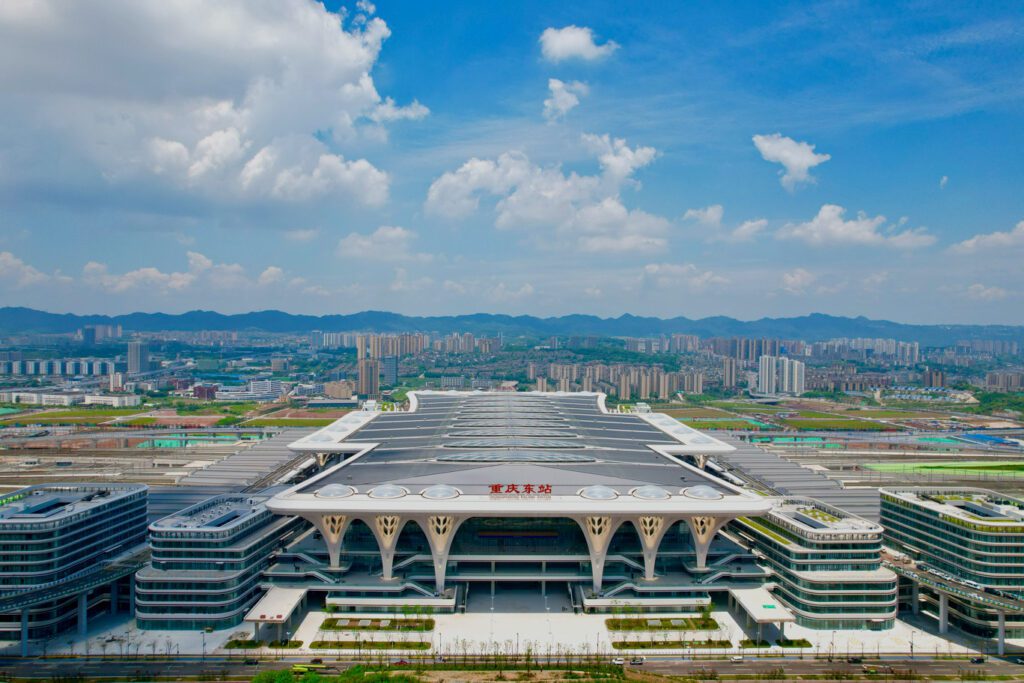
China completed the world’s largest railway station In just 38 months. Chongqing East Railway Station showcasing the country’s rapid infrastructure capabilities and growing use of advanced construction technology. The station is located in Chongqing, one of China’s largest and most economically important megacities. During a recent visit to China alongside US President Donald Trump’s business delegation, Elon Musk reshared a video showing the station’s construction process, drawing attention to the project despite his earlier scepticism about public transportation systems.
Also Read: Nepal Raises Objection Over Lipulekh Pass Route for Kailash Mansarovar Yatra
China Made Chongqing East showcases rapid infrastructure growth
Chongqing’s rise as an industrial powerhouse dates back to the 1960s under Mao Zedong’s Third Front Campaign. The initiative shifted major industrial and infrastructure investments away from China’s eastern coastline into inland regions to strengthen economic and strategic resilience. Chongqing became one of the biggest beneficiaries, receiving investments in manufacturing, railways, energy, and heavy industry. Over time, these developments transformed the city into a major centre for production, trade, and logistics in western China.
Today, Chongqing generates more than $440 billion annually and plays a critical role in China’s domestic and international trade network. To support rising transport demand and strengthen connections with coastal markets, China developed Chongqing East Railway Station as a major high-speed rail hub. Covering 1.22 million square metres, the station includes 15 platforms and 29 tracks and integrates rail, metro, buses, taxis, and coaches into a single multi-level transport system capable of handling around 16,000 passengers per hour.
Also Read: Property Row Erupts as BJP Targets Abhishek Banerjee, TMC Calls Claims False
China achieved this pace largely through a robotics-driven construction model. According to Chinese reports, engineers deployed AI-powered screed robots, robotic glass installers, automated welding systems, and 24/7 inspection robots across the site. These machines increased efficiency, reduced labour costs, improved precision, and significantly lowered workplace risks. Chongqing East now stands as a symbol of China’s ability to combine long-term industrial planning with large-scale technological execution.




More Stories
CJP आंदोलन पर हरीश साल्वे का बड़ा दावा, बोले- भारत में नेपाल और बांग्लादेश जैसे हालात बनाने की कोशिश
दिल्ली में विपक्ष के मार्च के बीच BJP का प्रदर्शन, कांग्रेस सांसद पर यौन शोषण का गंभीर आरोप, बांसुरी स्वराज ये बोलीं
राहुल के प्रदर्शन से पहले दिल्ली पुलिस अलर्ट, सुरक्षा के किए कड़े इंतजाम