





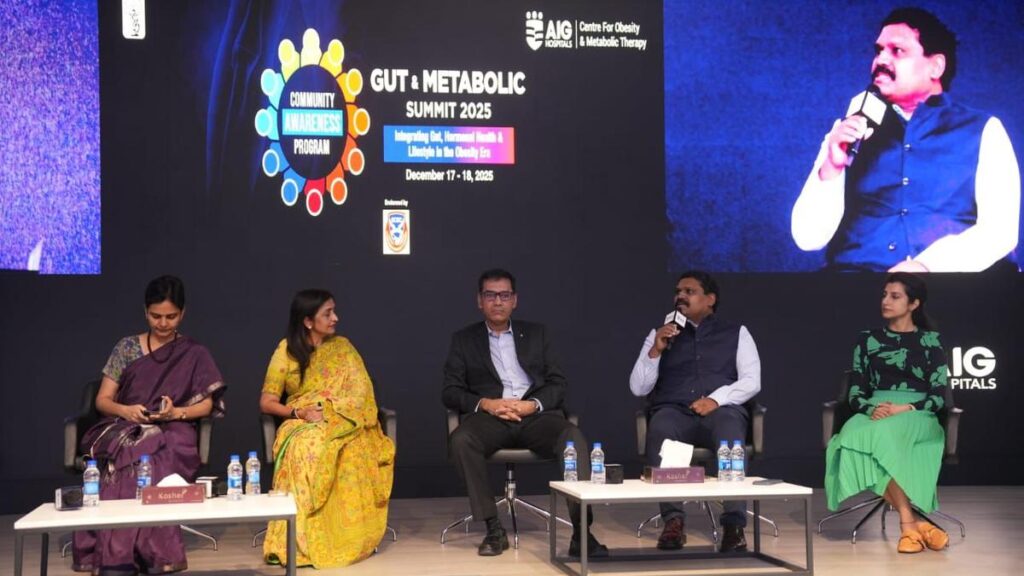
Speakers at a panel discussion on public–private collaboration at AIG Hospitals, Hyderabad, on Thursday, December 18, positioned rural women and community institutions as key drivers of India’s response to the growing burden of obesity and metabolic diseases.
Dr Rakesh Kalapala, Director of the Centre for Obesity and Metabolic Therapy at AIG Hospitals, moderated the discussion titled The Public-Private Collaboration to Tackle the Metabolic Crisis. The panel brought together Telangana Commissioner of Civil Supplies Stephen Raveendra; Chief Executive Officer of the Society for Elimination of Rural Poverty (SERP), Telangana, Divya Devarajan; Executive Director of Heritage Foods Nara Brahmani; Executive Director of Granules India Uma Chigurupati; and Chief Executive Officer of AIG Hospitals SAM Rizvi.
Opening the session, Dr Kalapala said metabolic disease had emerged as a silent pandemic driven by changing food habits, rising stress and sedentary lifestyles in both urban and rural India. He said solutions must extend beyond hospitals and actively involve governance systems, industry stakeholders and community institutions.
Also Read:Vijay returns to campaign calls DMK evil and positions TVK as the pure choice
Experts stress public–private collaboration and rural women’s leadership to curb India’s rising metabolic diseases burden
Placing rural women at the centre of the discussion, Ms Devarajan said government food systems and welfare programmes had decisively shaped dietary patterns over several decades. She pointed out that large-scale distribution of polished rice through the public distribution system had gradually displaced traditional diets based on millets such as jowar and ragi, which offer higher nutritional value and a lower glycaemic index. While earlier policies addressed food scarcity, she said the current phase of food self-sufficiency allows policymakers to rethink food baskets.
Addressing the role of public servants, Mr Raveendra said metabolic disease directly reduces productivity and operational readiness, particularly among police personnel who work under high stress, irregular schedules and limited access to healthy food.
From the food industry’s perspective, Ms Brahmani said India risks turning its demographic advantage into a liability if stakeholders fail to address childhood obesity and metabolic disorders. She said early-life nutrition would shape future health outcomes and urged food processing companies to protect nutritional value from farm to factory through farmer education and nutrient-preserving technologies.
Ms Chigurupati said the pharmaceutical industry now focuses increasingly on prevention and personalised healthcare rather than treatment alone. She said early diagnostics, evidence-based nutraceuticals, wearable technologies, genomics and artificial intelligence already help identify metabolic risks before disease onset.
Summing up the healthcare system’s role, Mr Rizvi said metabolic disorders such as diabetes, hypertension and fatty liver disease silently accumulate damage and impose heavy personal, organisational and economic costs. He said tertiary care hospitals must build awareness, engage policymakers, invest in research and develop evidence-based preventive health check-ups.
Also Read:Maharashtra Village of 1,500 Reports 27,000 ‘Births’ in Just Three Months




More Stories
Jio Platforms IPO Sets Global Record With Over 1 Crore Applications
Maharashtra Man Chased, Run Over and Beaten to Death on Busy Road; CCTV Captures Brutal Murder
Jio Platforms IPO में निवेशकों की भारी दिलचस्पी, तीसरे दिन सब्सक्रिप्शन 6 गुना के पार पहुंचा