



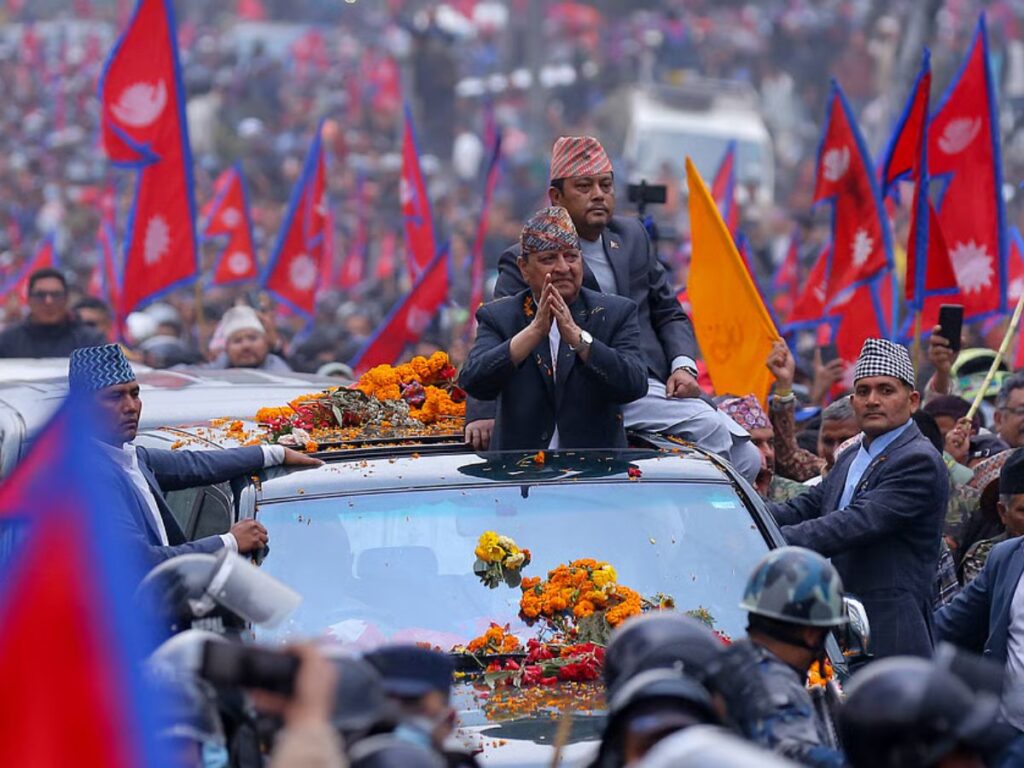
Nearly two decades after Nepal abolished its 239-year-old monarchy, former King Gyanendra Shah has re-entered public debate through carefully timed appearances and statements. Supporters recently welcomed him in Kathmandu with royalist slogans, reflecting lingering nostalgia among certain groups. Shortly before the parliamentary elections, Shah released a message questioning whether polls should proceed without broader national consensus, arguing that the country faces deep political and institutional distress. His remarks directly targeted citizens who feel disillusioned with Nepal’s unstable governance since 2008.
Also Read: Asia stocks fall as oil rises for a third day on Iran war concerns
Since the monarchy ended, Nepal has experienced frequent government changes, multiple prime ministers, and fragile coalitions. Moreover, political instability and economic hardship have frustrated voters, especially younger generations demanding systemic reform. A youth-led movement last year intensified criticism of established parties and pushed for an interim administration to oversee fresh elections. Consequently, conversations about alternative political models, including a ceremonial monarchy, have resurfaced in public discourse.
Why Nepal Monarchy Debate Persists
The Rastriya Prajatantra Party, which secured seats in parliament, openly supports restoring a constitutional monarchy and redefining Nepal as a Hindu state. Party leaders argue that a symbolic monarch could stand above partisan politics and serve as a unifying national figure. They insist that political parties would still govern while the monarchy would safeguard identity and stability.
However, critics strongly oppose this proposal. Former Prime Minister Baburam Bhattarai maintains that Nepal’s Constituent Assembly lawfully replaced monarchy with a secular democratic republic and warns that reviving royal authority could undermine constitutional values. Political analyst CK Lal suggests that Shah’s public visibility reflects an attempt to remain relevant rather than a genuine political comeback. He notes that while monarchy retains emotional resonance among older conservatives, younger citizens lack direct experience of royal rule and largely view it as outdated.
Nepal’s Future: Democracy or Restoration
Debate also surrounds proposals to restore Nepal’s status as a Hindu state. Supporters frame this shift as cultural preservation rooted in the historical philosophy of King Prithvi Narayan Shah, who described Nepal as strategically positioned between India and China. They argue that traditional principles could guide foreign policy and national unity.
Nevertheless, opponents counter that modern Nepal operates within a vastly different global and constitutional framework. They emphasize that democratic institutions, rather than royal symbolism, must address governance failures and social diversity. Although royalist rallies continue, most analysts believe the monarchy currently lacks sufficient political momentum for restoration. For now, Nepal’s electoral process will test whether democratic reform can satisfy public expectations or whether nostalgia for the past will persist on the margins of national politics.
Also Read: Yash postpones Toxic avoids clash with Dhurandhar 2


More Stories
नेपाल में बालेन शाह की पार्टी RSP ने दर्ज की बड़ी जीत अन्य पार्टियां काफी पीछे
IND vs NZ T20 World Cup Final: What Kind of Pitch Will Ahmedabad Offer
कौन हैं मोजतबा ख़ामेनेई, जिन्हें अगल सुप्रीम लीडर माना जा रहा है