





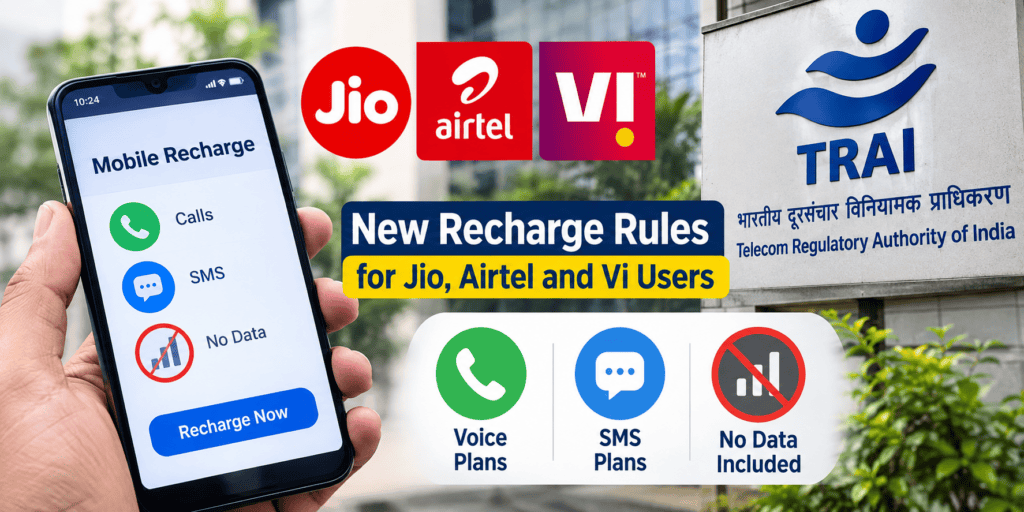
The Telecom Regulatory Authority of India (TRAI) has introduced new consumer protection rules for mobile recharge plans. The amendment requires telecom operators to provide more voice-and-SMS-only recharge options. Reliance Jio, Bharti Airtel and Vodafone Idea (Vi) will need to expand these plans. The new options will target customers who rarely use mobile data services. TRAI aims to provide affordable choices for low-income users and senior citizens. The rules will also benefit customers who depend mainly on Wi-Fi for internet access. Operators must offer voice-and-SMS-only plans for validity periods of 30 days or less. These plans must correspond with existing bundled recharge periods offered by operators. Companies must also reduce the tariffs appropriately for these data-free plans. TRAI expects the changes to give customers greater flexibility when selecting prepaid mobile services. The regulator introduced these measures after reviewing existing recharge options across telecom operators.
Also Read : Swara Bhasker Criticises Padmaavat’s Jauhar Sequence, Questions Its Message About Women
TRAI Expands Voice-and-SMS-Only Recharge Options
The new rules also introduce specific requirements for monthly renewal options. Telecom companies must provide at least one voice-and-SMS-only plan that renews monthly. Customers should receive an option to recharge on the same date each month. If that date does not occur, the plan should renew on the month’s final day. This requirement could make monthly recharges easier for customers to manage. Operators must also provide longer-validity voice-and-SMS-only vouchers for eligible customers. These vouchers should correspond with longer-validity bundled plans already available from operators. TRAI said telecom companies previously offered limited choices without bundled mobile data. Most available voice-and-SMS vouchers focused on longer validity periods. This situation reduced affordable short-term choices for customers who needed basic services. The regulator therefore decided to expand shorter-validity options across telecom operators. The changes will apply to major operators offering prepaid mobile services in India.
TRAI began the regulatory process after identifying limited choices among existing voice-only recharge vouchers. The regulator released the draft Telecom Consumer Protection (Thirteenth Amendment) Regulations, 2026, for consultation. TRAI published the draft proposal on April 7, 2026, for stakeholder feedback. The consultation process received 1,132 responses from different stakeholders and industry participants. TRAI later conducted an Open House Discussion on June 15, 2026. Officials reviewed the suggestions before finalising the amended consumer protection regulations. The regulator also conducted its own analysis of existing telecom recharge offerings. TRAI said the consultation helped identify consumer concerns surrounding voice-and-SMS-only plans. The final amendment focuses on affordability, flexibility and access to suitable prepaid options. The rules specifically address customers who do not require regular mobile data services. They also create additional choices for customers who prefer Wi-Fi-based internet connectivity. Telecom operators must now adjust their offerings according to these requirements.
Also Read : From Farms to Factories: How AI Is Transforming India’s Food Supply Chain
Monthly Renewal and New Validity Rules for Jio, Airtel and Vi Users
The new provisions could change how customers select prepaid recharge plans. Users who primarily make calls and send messages can choose plans without mobile data. Such customers may avoid paying for data services they rarely use. People who regularly connect through home, office or public Wi-Fi could also benefit. Senior citizens and low-income users may receive additional choices under the revised framework. However, actual savings will depend on the prices and benefits announced by individual operators. The new rules do not guarantee a fixed discount across all recharge plans. Instead, TRAI requires operators to price comparable voice-and-SMS-only plans appropriately. Customers will therefore need to compare available plans before selecting their preferred recharge option. The monthly renewal requirement could also simplify the recharge schedule for prepaid users. Customers may find monthly validity easier to remember than shorter 28-day recharge cycles. The amendment focuses on increasing consumer choice rather than removing existing bundled recharge plans.
The revised rules do not require telecom operators to convert every 28-day plan into 30-day plans. Their main objective involves expanding voice-and-SMS-only recharge choices for consumers. Many prepaid plans currently provide 28 days of validity instead of a complete calendar month. This difference can require customers to complete more recharges during an entire year. For example, a ₹299 plan with 28-day validity could require 13 recharges annually. Under the same price assumption, those 13 recharges would cost ₹3,887 in total. A ₹299 plan offering 30-day validity could require only 12 yearly recharges. Twelve such recharges would cost ₹3,588 under the same pricing assumption. However, this example only illustrates the effect of different validity periods. Actual operator pricing and plan benefits may differ after the new rules take effect. Customers should check the latest recharge details before making their purchase decisions. The amendment mainly expands basic-service options rather than replacing existing mobile plans.
Also Read : Swara Bhasker Criticises Padmaavat’s Jauhar Sequence, Questions Its Message About Women




More Stories
अलवर में मां ने दो बच्चों की हत्या कर की आत्महत्या, बचाने आई बहन घायल
Mona Agarwal, Avani Lekhara Win Gold and Silver for India at Asian Para Games
Economist Who Predicted 2008 Financial Crisis Warns India Must Accelerate Growth to Create Jobs