





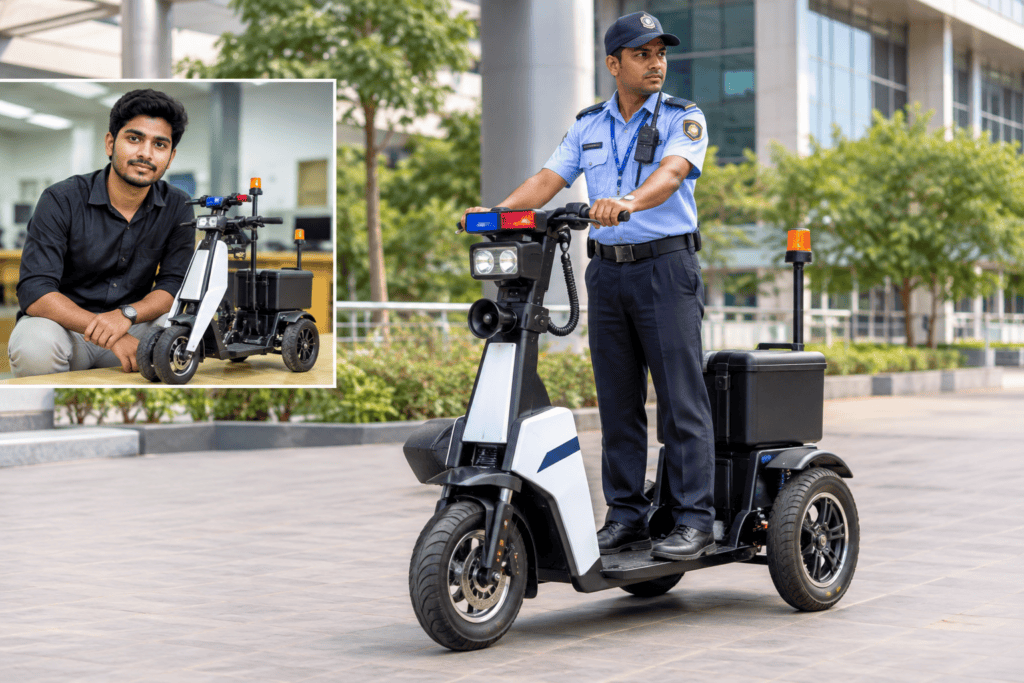
Indian student Shakeel Akthar S has earned national recognition for developing Trike 2π, a compact electric patrol vehicle. The project secured the India national runner-up position at the James Dyson Award 2026. Akthar currently studies Industrial Automation and Robotics at Kumaraguru College of Technology in Coimbatore. He developed the vehicle after observing the challenges security personnel face during long patrols. The idea emerged during his undergraduate studies while his team worked across a 150-acre campus. Instead of modifying an existing vehicle, the team created a dedicated electric mobility solution. Trike 2π uses a three-wheel design that combines stability with easy manoeuvrability. The vehicle helps security personnel move through large pedestrian areas more efficiently. Its compact structure allows riders to navigate crowded locations and narrow spaces. The project has now moved beyond a campus concept and entered real-world security applications.
Also Read : Swara Bhasker Criticises Padmaavat’s Jauhar Sequence, Questions Its Message About Women
Compact Design Improves Patrol Mobility
Trike 2π features a front-wheel-drive electric system and a three-wheel architecture. Its front hub-driven wheel provides a wide steering angle for tight turns. The two rear wheels rotate independently, helping the vehicle move through confined areas. The vehicle can reportedly turn within a radius of around five feet. A standing platform gives riders better visibility while they patrol public spaces. The platform also allows riders to mount, dismount and interact with people quickly. Independent coil suspension on each wheel improves stability on uneven surfaces. The mild-steel chassis keeps the centre of gravity low during operation. A 250W motor provides the required power while meeting low-speed vehicle regulations. The team also added lighting, beacon lights, GPS, a siren and a public address system. These features make the vehicle suitable for campuses, railway stations and other large pedestrian environments.
The development team created four major versions before finalising the current Trike 2π design. The first prototype tested the standing patrol concept and compact three-wheel structure. Campus security personnel tested the vehicle and highlighted problems with ride comfort. The team responded by adding independent coil suspension to the second version. Engineers also improved ergonomics and lowered the vehicle’s centre of gravity. Further testing on uneven surfaces revealed limitations in the front-wheel braking system. The team then developed a mechanical braking system for both rear wheels. A single brake lever now distributes braking force across the rear wheels. The final version added several features designed for practical security operations. More than 50 users from different age groups and professions reportedly tested various versions. Their feedback helped the team improve comfort, safety, handling and overall usability. The development process transformed the initial campus idea into a more practical patrol vehicle.
Also Read : From Farms to Factories: How AI Is Transforming India’s Food Supply Chain
James Dyson Award : Police and Railway Forces Use the Vehicle
Trike 2π has now moved from student research into real-world security operations. Coimbatore City Police reportedly use the electric vehicle for patrol duties. Ten units have also been deployed at Chennai Central Railway Station. Railway Protection Force personnel use the vehicles to support surveillance and patrol activities. The project has also created an entrepreneurial opportunity for Akthar through Elaicle Innovations Private Limited. The startup has received support from IPTIF for further product development. The project has secured several awards, grants and institutional recognitions during its development. These include the IEI Research Excellence Award and an AICTE-MIC YUKTI Innovation Challenge grant. The team also received Rs 2 lakh through the NewGen IEDC programme. IPTIF IMPACT 3.0 provided another Rs 10 lakh for product development. These grants and recognitions helped the team improve the prototype and explore practical deployment. The project now focuses on testing, validation and further engineering improvements.
The team plans to complete its first production batch and conduct operational validation. Railway Protection Force personnel will provide feedback during the next stage of deployment. Engineers will use this feedback to improve the vehicle and complete further testing. The team also plans to focus on certification and regulatory compliance before expanding production. Future deployment could cover universities, airports, hospitals and industrial facilities. The developers also plan a second-generation model with rear-wheel drive for off-road applications. A third-generation version could introduce battery swapping for continuous patrol operations. Such upgrades could help security teams operate the vehicles for longer periods. The James Dyson Award project page has placed Trike 2π in global consideration. The project will now compete for a position among the award’s global Top 20 shortlist. Its progress shows how a student engineering project can move toward practical public-use applications.
Also Read : Swara Bhasker Criticises Padmaavat’s Jauhar Sequence, Questions Its Message About Women




More Stories
मेरठ ब्लू ड्रम हत्याकांड: मुस्कान और साहिल को मृत्युदंड, सौरभ राजपूत की हत्या में कोर्ट का बड़ा फैसला
Meloni Calls US-Russia Diesel Deal a Risky Choice Amid Ukraine War
बिहार के राघोपुर में नाव पलटने से 13 बच्चों की मौत, स्थानीय लोगों ने क्या बताया?