





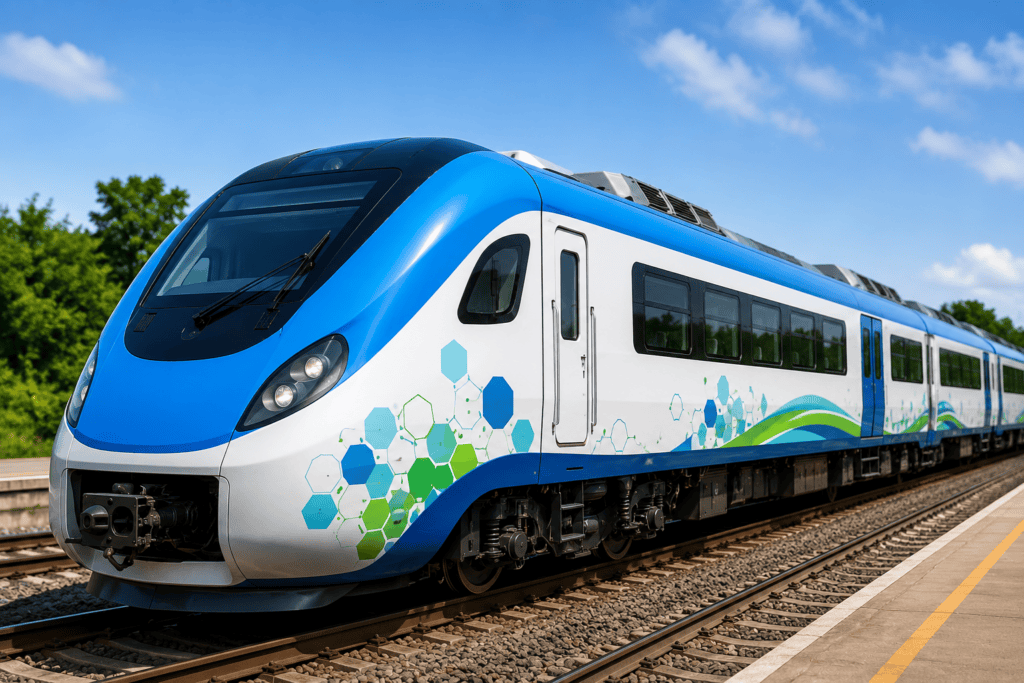
India has launched its first indigenously developed hydrogen fuel cell train on the Jind–Sonipat route in Haryana, taking a significant step toward green transportation. The pilot project will help Indian Railways gain operational experience while building the infrastructure needed for hydrogen-powered trains. With this achievement, India joins countries like Germany, Japan, China, and the United States in exploring hydrogen-based rail technology. The initiative also supports the National Green Hydrogen Mission and the Atmanirbhar Bharat campaign, reinforcing the country’s commitment to cleaner and more sustainable public transport.
Also Read : U.S. Launches More Strikes on Iran as Tensions Rise; Bangkok Pub Fire Kills 27
Hydrogen Fuel Cell Powers the Green Engine
The train runs on a 1,200-kilowatt Proton Exchange Membrane Fuel Cell (PEMFC), which generates electricity through a chemical reaction between hydrogen and oxygen. Compressed hydrogen stored in high-pressure cylinders flows into the fuel cell, where a catalyst separates hydrogen into protons and electrons. The electrons move through an external circuit to generate electricity, powering the train’s traction motors. Oxygen from the surrounding air then combines with the hydrogen particles, producing only water vapour and heat. Since the process does not involve combustion, the train operates without smoke or direct carbon emissions.
To improve efficiency, Indian Railways has integrated Lithium Iron Phosphate (LFP) batteries with the fuel cell system. These batteries store excess electricity, provide additional power during acceleration, and recover energy through regenerative braking. This hybrid technology reduces hydrogen consumption while improving overall performance. Hydrogen also offers a higher energy density than diesel, enabling the train to deliver strong performance with lower environmental impact. The cleaner technology can also reduce maintenance costs because it contains fewer mechanical components than conventional diesel engines.
Advanced Infrastructure Ensures Safe Operations
Indian Railways has built India’s largest railway hydrogen storage and refuelling facility at Jind to support the project. The facility can store nearly 3,000 kilograms of hydrogen and meets international safety standards. Engineers have equipped the train with hydrogen leak detectors, flame detection systems, continuous ventilation, automated shutdown mechanisms, and real-time monitoring technology. Trained technical teams will supervise the initial operations to ensure safe and reliable performance while collecting valuable operational data.
The 10-coach train, consisting of two Hydrogen Driving Power Cars and eight passenger coaches, can carry around 2,600 passengers. It will operate between Jind Junction, Gohana Junction, and Sonipat, serving several stations along the route. Indian Railways expects the pilot project to provide valuable insights before introducing hydrogen-powered trains on a larger scale. Beyond launching a new train, the initiative strengthens India’s clean energy infrastructure and supports the country’s long-term goal of achieving sustainable, low-carbon transportation.
Also Read : U.S. Launches More Strikes on Iran as Tensions Rise; Bangkok Pub Fire Kills 27




More Stories
Rahul Gandhi’s Convoy Cars Collide With Ambulance on UP Expressway
Jio Platforms IPO Sets Global Record With Over 1 Crore Applications
Maharashtra Man Chased, Run Over and Beaten to Death on Busy Road; CCTV Captures Brutal Murder