




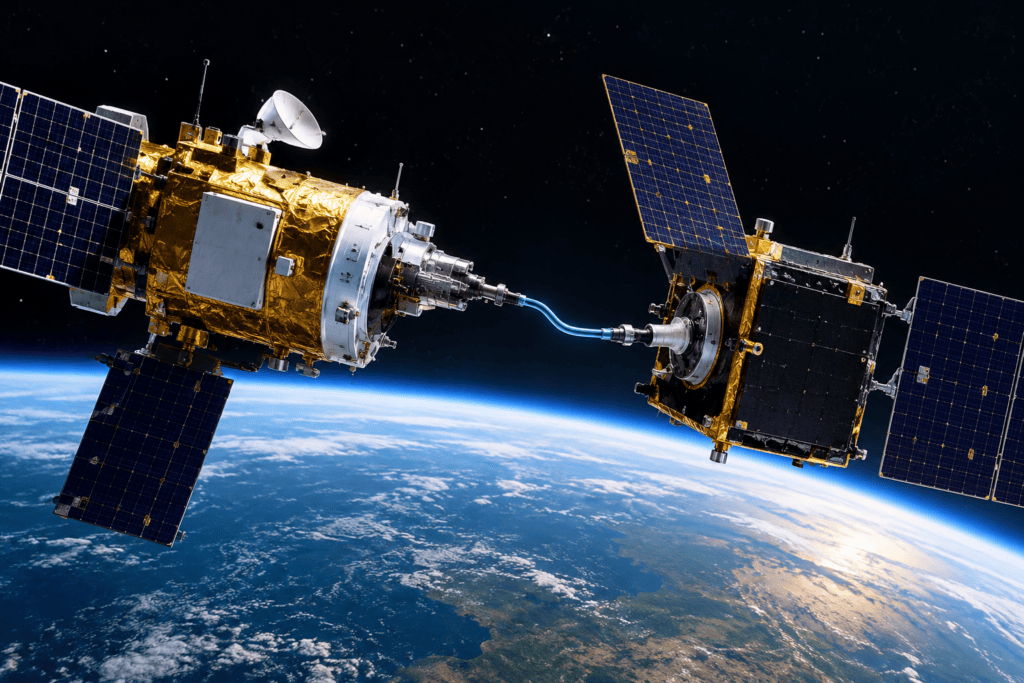
India’s space startup OrbitAID Aerospace is preparing to demonstrate a technology that could allow satellites to refuel in orbit. The company plans to launch its AayulSAT-1A satellite aboard the Small Satellite Launch Vehicle (SSLV) in November 2026. The satellite weighs approximately 30 kilograms and will test docking, refuelling and inspection technologies in space. OrbitAID founder and CEO Sakthikumar R said the satellite is ready for its final tests. The team plans to complete these checks before shipping the spacecraft to Sriharikota for launch preparations. The company has tentatively targeted mid-November, although officials have not confirmed the exact launch date. The mission aims to establish a foundation for commercial satellite servicing and longer spacecraft lifespans. If the technology succeeds, operators could eventually refuel satellites instead of replacing them when their fuel supplies run low.
Building a Petrol Pump in Space
OrbitAID Aerospace aims to bring the concept of a petrol pump into space through its upcoming mission. Instead of abandoning satellites when they run out of fuel, operators could use specialised servicing spacecraft to approach and refuel them. This technology could extend satellite lifespans and reduce the expense of launching replacement spacecraft. AayulSAT-1A will carry two satellite buses, two tanks and the mechanisms needed to conduct its experiments. The company will use these components to test docking and internal refuelling procedures. OrbitAID also plans to examine power transfer, data transfer and in-orbit inspection capabilities. These experiments will help engineers evaluate how effectively the systems work under space conditions. The company believes that successful demonstrations could support future commercial servicing missions. However, engineers must first establish that the technology can operate safely and reliably before customers can use it regularly.
OrbitAID has expanded its mission plans by incorporating additional payloads and technical capabilities into AayulSAT-1A. Sakthikumar said the upcoming flight would go beyond repeating the objectives of an earlier mission. The company continued developing its technology after a launch anomaly affected the PSLV-C62 mission in January 2026. OrbitAID now plans to validate internal docking, refuelling, power transfer, data transfer and inspection systems. The satellite will help engineers assess how these mechanisms perform during orbital operations. The company has not disclosed every innovation onboard, as it intends to share some details after launch. Its team plans to complete final testing before transporting the spacecraft to Sriharikota. The results could help engineers identify technical limitations and improve future designs. Reliable docking and fuel transfer remain essential challenges because spacecraft must connect accurately while operating in demanding conditions. OrbitAID hopes to address these challenges through a series of demonstrations.
Also Read : UP Shock: Two Saints Murdered, Bodies Burnt Inside Shahjahanpur Temple
Bigger Satellite-Servicing Mission Planned for 2027
OrbitAID is preparing another advanced mission for the first quarter of 2027. The planned demonstration will involve two satellites, a chaser and a target, to test rendezvous and proximity operations. The chaser spacecraft will approach the target and demonstrate docking and other servicing procedures. OrbitAID also intends to test refuelling capabilities and additional technologies during the mission. The company is developing a propulsion demonstration that it describes as a “jet-pack” experiment. This technology aims to help spacecraft manoeuvre in orbit and potentially assist other satellites. Engineers will first test the propulsion system on the company’s own spacecraft before considering applications involving operational satellites. OrbitAID has already started manufacturing hardware for the 2027 mission. The company expects integration work to begin around December, following its upcoming mission activities. These experiments will help the team assess the performance of its propulsion and servicing systems. OrbitAID hopes to use the results to advance its technology towards practical applications.
OrbitAID’s planned missions could support the development of a growing market for in-space servicing. Satellite operators increasingly depend on spacecraft for communications, navigation, Earth observation and other essential services. Refuelling and servicing technologies could help operators keep these satellites working for longer periods. Instead of replacing spacecraft when they exhaust their fuel, companies could eventually send servicing vehicles to replenish supplies and perform inspections. Such operations could reduce replacement costs and help operators make better use of expensive space assets. However, companies must overcome significant engineering challenges before commercial services become routine. Spacecraft need precise navigation, reliable docking systems and safe methods for transferring fuel in orbit. Engineers must also demonstrate that servicing vehicles can operate consistently across different missions. OrbitAID plans to use its 2026 and 2027 demonstrations to advance these capabilities. Successful tests could strengthen India’s role in the emerging satellite-servicing sector.



More Stories
दिल्ली-NCR में बदला मौसम, धूल भरी आंधी के साथ बारिश और ओलावृष्टि का अलर्ट जारी
Jio’s Rs 30,213 Crore IPO: How It Differs From LIC, Hyundai and NSE
Actor Imran Khan Asked to Leave India Days After Taking Part in CJP Protest