



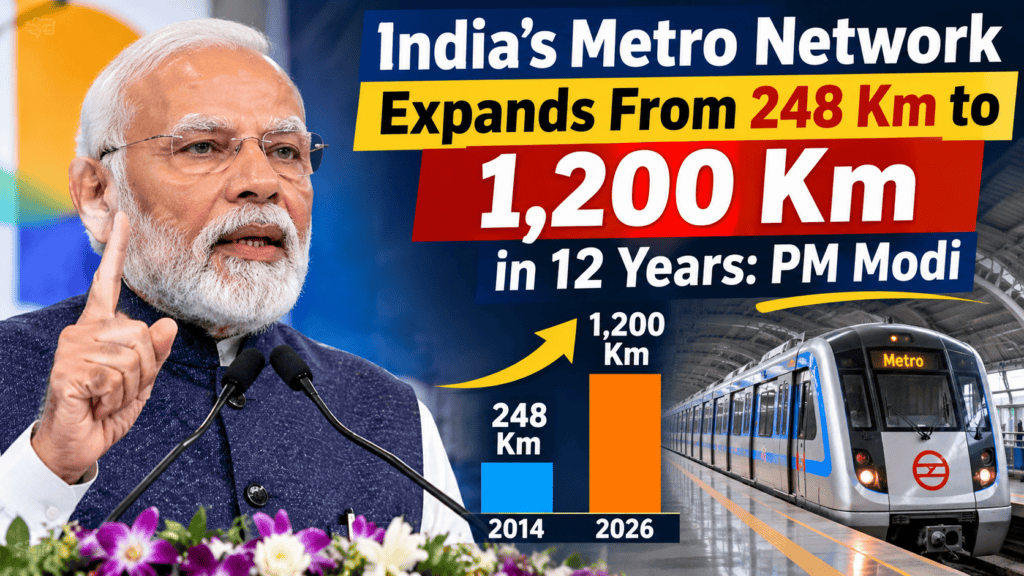
Prime Minister Narendra Modi on Tuesday, November 3, highlighted India’s remarkable growth in urban transportation and said the country’s operational metro network had expanded from 248 kilometres in 2014 to nearly 1,200 kilometres. He shared these figures while inaugurating Pune Metro’s 23-kilometre Pink Line through video conferencing. Modi said the government had focused on improving transportation facilities and making daily travel easier for people living in urban areas. He added that better connectivity would improve the quality of life for millions of citizens. According to the Prime Minister, India has made significant progress in developing modern transport infrastructure over the past 12 years. He also stressed that improved urban mobility would support economic activities and strengthen the country’s overall development. The expansion reflects India’s growing investment in modern public transportation systems.
Also read :Indian Seafarer Killed in Aerial Strike on Cargo Ship Off Oman; MEA Responds
Four New Metro Corridors Announced Under Pune Metro Phase II
Modi also highlighted the growing reach of metro services across the country. He said India had metro connectivity in only five cities in 2014, but the network now operates across 26 cities. More than one crore passengers use metro services every day, making the system an important part of urban transportation. The Prime Minister also noted that India now ranks among the world’s three largest metro networks. He said this expansion reflects the government’s commitment to improving public transport and reducing the difficulties of daily commuting. Metro services help passengers travel more comfortably while avoiding heavy traffic on city roads. They also reduce dependence on private vehicles and support cleaner transportation. The government continues to expand metro infrastructure to connect residential areas, commercial centres and major employment hubs. These developments aim to make urban travel faster and more convenient.
During the programme, Modi inaugurated Pune Metro’s 23-kilometre Pink Line, which connects the Hinjewadi IT hub with the District Court Metro station. The project involved an investment of more than Rs 8,300 crore. The new corridor aims to improve connectivity for thousands of IT professionals and other daily commuters. It will also help reduce traffic congestion and encourage people to use public transportation instead of private vehicles. The Pink Line will operate with women train operators, highlighting their growing participation in the transportation sector. Officials have also incorporated sustainable energy arrangements into the project. Around 30 per cent of the corridor’s electricity requirements will come from solar power. The new metro connection is expected to strengthen transportation facilities between Pune’s important residential, commercial and employment areas while supporting the city’s growing infrastructure needs.
Metro Services Now Operate in 26 Cities
Apart from inaugurating the Pink Line, the Prime Minister laid the foundation stone for four additional metro corridors under Pune Metro Phase II. The proposed corridors include Lines 2A, 2B, 4 and 4A. The government estimates the Phase II project will cost approximately Rs 13,500 crore. These corridors will connect several important residential, commercial and information technology areas across Pune. The overall investment in the newly inaugurated and upcoming metro projects stands at around Rs 21,800 crore. The expansion will strengthen public transportation and improve connectivity between different parts of the city. It will also provide better travel options to employees, students and residents. Modi said stronger metro connectivity would save commuting time and improve the city’s productivity. The projects also reflect the government’s broader plan to develop modern urban infrastructure and support growing cities.
Modi emphasised that modern infrastructure plays an important role in India’s economic development. He said cities do not serve merely as residential centres but also act as major engines of economic activity. Better transportation helps people save time, reach workplaces easily and participate more effectively in economic activities. The Prime Minister explained that improved urban infrastructure would benefit both middle-class families and economically weaker sections. He also highlighted the importance of developing smaller cities as future growth centres. The government aims to strengthen connectivity through metro networks, highways, expressways and modern railway systems. Modi said these infrastructure investments would create employment opportunities for workers, engineers and businesses. He expressed confidence that continued development would help Indian cities become more competitive and improve the country’s overall growth. The government sees modern urban transportation as an important part of its vision for a developed India.



More Stories
स्कॉर्पियो की टक्कर से बाइक सवार दो लोगों की मौत, CCTV में कैद हुआ दर्दनाक हादसा
High Court Criticises ‘Loose Comments’ on Dia Mirza’s Diwali Ad, Directs BMC to Restore Video
बद्रीनाथ हादसे के बाद DGCA का बड़ा फैसला, दो पायलट अनिवार्य होने पर निजी हेलीकॉप्टर ऑपरेटरों ने रोकी सेवाएं