





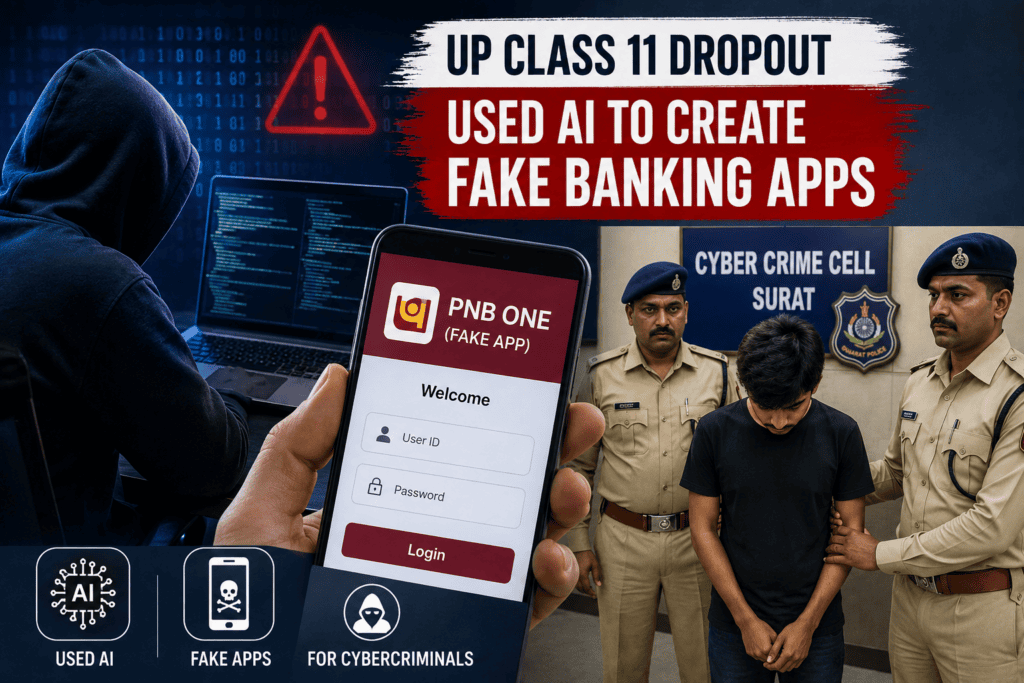
The Surat Cyber Crime Cell has arrested an 18-year-old from Kanpur, Uttar Pradesh, up for allegedly developing fake banking applications and malicious APK files that cybercriminals used to carry out financial fraud. Police identified the accused as Rohit Virendra Singh Shakya, who reportedly studied only up to Class 11. up Investigators said he learned to use artificial intelligence tools and Telegram to create advanced malware and counterfeit banking applications. According to officials, he began building these tools at the age of 16 and allegedly supplied them to cybercrime groups operating in different parts of the country. up Authorities believe his software enabled criminals to target unsuspecting users through convincing fake applications that closely resembled genuine banking platforms. The arrest has exposed a wider cybercrime network, and investigators have expanded the probe to identify others involved in the operation.
Surat Police arrest 18-year-old accused of creating AI-powered fake banking apps
The investigation started after a cyber fraud complaint was registered in Surat in May 2026. According to police, a victim received an APK file on WhatsApp that appeared almost identical to Punjab National Bank’s official PNB One application. Trusting the message, the victim downloaded and installed the application on the mobile phone. Shortly after installation, cybercriminals allegedly gained access to the device and transferred ₹5 lakh from the victim’s Prime Co-operative Bank account to another account in Union Bank within minutes. The incident prompted the Surat Cyber Crime Cell to launch a detailed digital investigation. By tracing technical evidence and online activities, investigators eventually reached the alleged developer behind the fake application, leading to a coordinated operation that resulted in his arrest in Kanpur.
A team comprising cybercrime officers and information technology experts conducted a raid at a hotel in Kanpur and arrested the suspect. During the operation, police seized a laptop, mobile phone and several digital devices believed to contain evidence related to the cyber fraud network. Investigators said the accused allegedly created two separate applications for each operation. One application was installed on the victim’s mobile phone, while another served as an administrator tool for cybercriminals. Through the admin application, fraudsters could reportedly monitor one-time passwords (OTPs), banking credentials, messages and other confidential information in real time. Officials believe this technology allowed criminals to bypass security measures and quickly execute unauthorized banking transactions without alerting victims immediately.
Investigation links malware apps to cyber fraud gangs across multiple states
Police also uncovered what they described as a subscription-based business model behind the alleged operation. According to investigators, the accused charged clients ₹15,000 for deploying the malicious software and collected an additional ₹15,000 every month for maintenance and continued access to the service. Officials said he allegedly developed customized fake applications that closely copied the appearance of banks, government departments and well-known companies based on customer demands. These included counterfeit applications and payment links imitating Punjab National Bank, State Bank of India, Axis Bank, UCO Bank, BigBasket, American Express and even RTO challan services. Investigators believe these fake platforms helped cybercrime syndicates trick victims into sharing sensitive financial information and installing malware on their devices.
During the investigation, police found evidence suggesting that several cybercrime gangs from Jamtara in Jharkhand, along with groups operating in Haryana and Rajasthan, allegedly obtained virus-infected applications from the accused. Officials are now examining digital records, financial transactions and communication channels to identify every individual connected to the network. Authorities have launched further investigations to determine the full scale of the operation and trace additional victims who may have suffered financial losses through these fake applications. Police have urged people to avoid downloading APK files received through WhatsApp, Telegram or unknown sources and to install banking applications only from official app stores. The case highlights the growing misuse of artificial intelligence in cybercrime and the increasing need for stronger digital awareness and cybersecurity practices.
Also read :Government-Congress ‘Understanding’ on NEET? Akhilesh Yadav Questions Discussion




More Stories
CJP आंदोलन पर हरीश साल्वे का बड़ा दावा, बोले- भारत में नेपाल और बांग्लादेश जैसे हालात बनाने की कोशिश
दिल्ली में विपक्ष के मार्च के बीच BJP का प्रदर्शन, कांग्रेस सांसद पर यौन शोषण का गंभीर आरोप, बांसुरी स्वराज ये बोलीं
राहुल के प्रदर्शन से पहले दिल्ली पुलिस अलर्ट, सुरक्षा के किए कड़े इंतजाम