



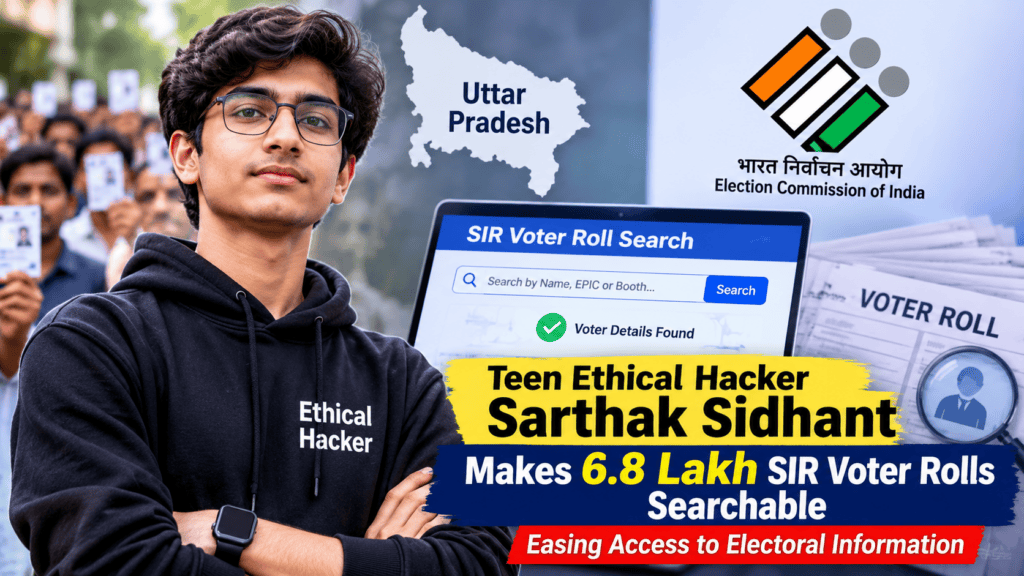
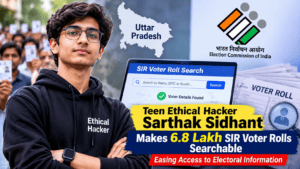
Making public information accessible remains a challenge for millions of citizens. Eighteen-year-old ethical hacker Sarthak Sidhant has addressed this problem by digitising Uttar Pradesh’s electoral rolls. He and his team converted 6.8 lakh PDF files into searchable records, covering approximately 54.8 crore voter entries across 403 Assembly constituencies. The initiative helps citizens locate voter details without manually checking lengthy scanned documents. Several people praised his efforts, saying the Election Commission of India should have provided such accessible records. The project includes four electoral roll sets, covering the 2024 Lok Sabha elections and subsequent SIR revisions. His initiative aims to simplify voter verification, encourage transparency and improve public access to electoral information.
Also read:Indian Developers to Present Projects at Moscow International Game Week
From CBSE’s OSM Controversy to Electoral Transparency
Sarthak previously attracted attention after questioning irregularities in CBSE’s On-Screen Marking system. His investigation began after he noticed discrepancies in his Class 12 examination results. He requested evaluated answer sheets and examined the board’s digital assessment process. He subsequently identified changes in tender documents and highlighted concerns regarding technical requirements and eligibility conditions. On June 2, he presented his findings before a Parliamentary Standing Committee on Education. Later, he created a database containing approximately 1.66 crore government procurement records. His work extended beyond education into public accountability. TIME100 Next India 2026 recognised his contributions on November 20. Four days later, he announced his latest voter roll digitisation initiative.
The digitisation project covered four electoral roll categories, including the 2024 Lok Sabha election records, SIR draft and final rolls, and the 2027 draft electoral roll. Sarthak explained that his team used Optical Character Recognition technology to extract information from scanned PDF documents. The process converted 6.8 lakh files into approximately 54.8 crore structured data rows. Researchers and voters can now search records without opening individual documents. The dataset organises information across Uttar Pradesh’s 403 Assembly constituencies. The team also introduced privacy safeguards by replacing sensitive identifiers with keyed-hash tokens. These measures help protect personal information while allowing users to verify original entries. The initiative makes electoral information easier to examine and compare.
Also read:Bihar MLC Election 2026: Neeraj Singh Leads in Patna, BJP Ahead in Tirhut
People Praise Sarthak for Making Electoral Rolls Accessible
Sarthak’s initiative received appreciation from politicians, journalists and civil society members. Congress MP Gaurav Gogoi supported the project and highlighted its importance for democratic accountability. He described citizens’ vigilance and institutional scrutiny as essential elements of democracy. Senior journalist Pankaj Pachauri also praised the teenager’s efforts. He called the initiative genuine public service and criticised the ECI for not undertaking similar work. The project arrives amid growing demands for machine-readable electoral rolls. Although Uttar Pradesh’s Chief Electoral Officer introduced searchable PDFs for the 2027 draft electoral roll, Sarthak’s initiative combines multiple electoral datasets. His work has strengthened public discussions about transparency, voter verification and accessible government information.
Sarthak’s latest initiative highlights how technology can improve access to essential public information. Electoral rolls play a crucial role in protecting citizens’ voting rights. Therefore, making these records searchable can help voters identify discrepancies and examine changes. His journey demonstrates how individual efforts can encourage greater institutional accountability. Starting with concerns about examination results, he expanded his work into procurement transparency and electoral data accessibility. At just 18, the Ranchi-based student has attracted national attention through his technology-driven initiatives. His latest contribution has also renewed discussions about the ECI’s responsibility to provide accessible electoral information. The project demonstrates how young innovators can use digital tools to support transparency and strengthen democratic participation.
Also read:Indian Developers to Present Projects at Moscow International Game Week

More Stories
WhatsApp का नया फीचर: अब 2 हफ्ते पहले शेड्यूल कर सकेंगे मैसेज
Pune Court Horror: Murder Accused Attacked With Sickle, Shots Fired Outside Court
उमर खालिद और शरजील इमाम को सुप्रीम कोर्ट से झटका, फिलहाल नहीं मिली अंतरिम जमानत