





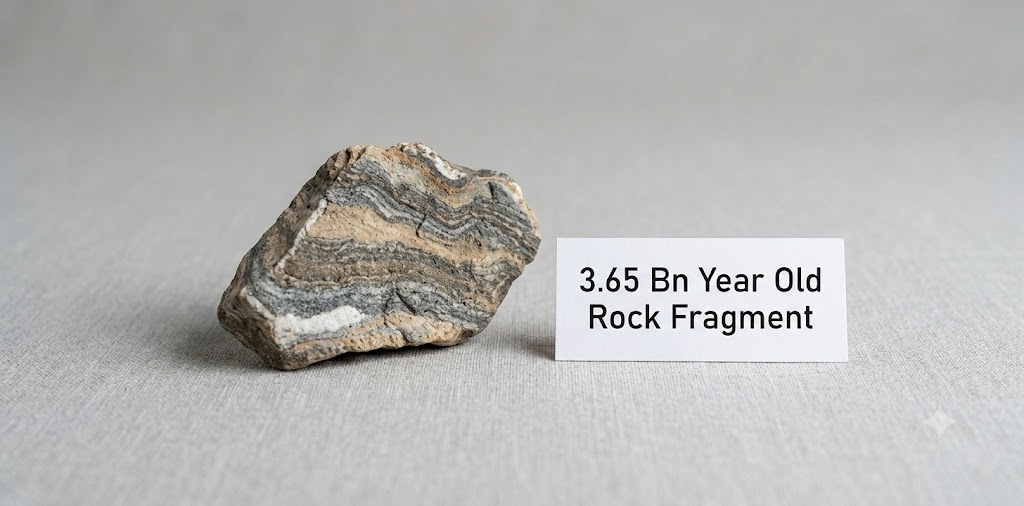
Scientists have discovered a rock fragment estimated to be around 3.65 billion years old in Bastar, Chhattisgarh. Researchers consider it the oldest known rock fragment found in India so far. The discovery could extend the country’s geological history by nearly 150 million years. The rock dates back to a time when Earth was cooling and developing its early crust. Scientists believe the finding can provide valuable clues about Earth’s ancient geological evolution.
Also Read : Two Workers Rescued Alive After 9 Days in Nepal Floods, Renewing Hope for More Survivors
India’s Geological History Gets Older
The discovery has pushed India’s known surviving rock record back by about 150 million years. Researchers have now placed Bastar ahead of Singhbhum in Jharkhand, which remained India’s oldest known geological region for decades. Earlier studies had estimated some rocks in Bastar to be around 3.56 billion years old. Scientists made the latest discovery along the Bhopalpatnam-Bijapur corridor. The region contains a craton that has survived major geological processes, including collisions, compression and melting.
A team from IISER Bhopal conducted the research under Professors Pritam Nasipuri and Kaushik Satpathy. Professor Kewuk Yi from the Korea Basic Science Institute and Abhijit Bhattacharya, former IIT Kharagpur professor, also contributed to the study. Their analysis identified three major geological events in the region’s early history. The first event occurred around 3.65 billion years ago, while the second took place between 3.64 and 3.60 billion years ago. Researchers reconstructed the third event between 3.44 and 3.40 billion years ago.
Ancient Gneiss Reveals Earth’s Early History
The researchers identified two distinct types of rocks during their study. Among them, they identified gneiss as the oldest rock type found in the area. The rock contains visible stripes that record its long and complicated geological journey. According to Professor Nasipuri, intense heat and partial melting deep inside Earth’s crust likely formed the gneiss. Scientists estimate that this process occurred around 30 to 50 kilometres beneath Earth’s surface. The rock therefore offers an important window into the conditions that existed during Earth’s earliest geological stages.
Also Read : Two Workers Rescued Alive After 9 Days in Nepal Floods, Renewing Hope for More Survivors



More Stories
अहमदाबाद के गरबा पंडाल में पहचान छिपाकर घुसने के आरोप में दो युवक पकड़े गए
Supreme Court Delivers Major Victory to Yes Bank Bondholders
Indian startup ready to launch petrol pump in space, test refuelling outside Earth