


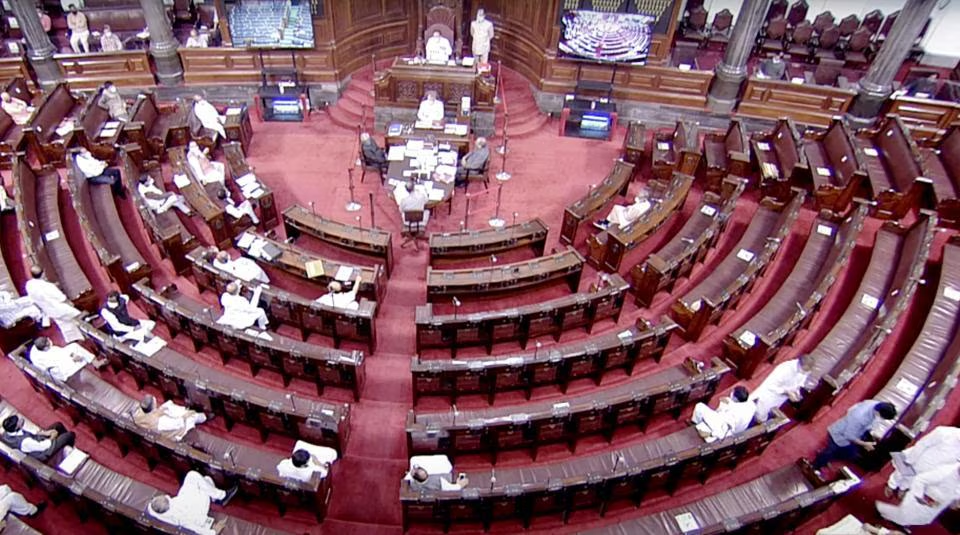

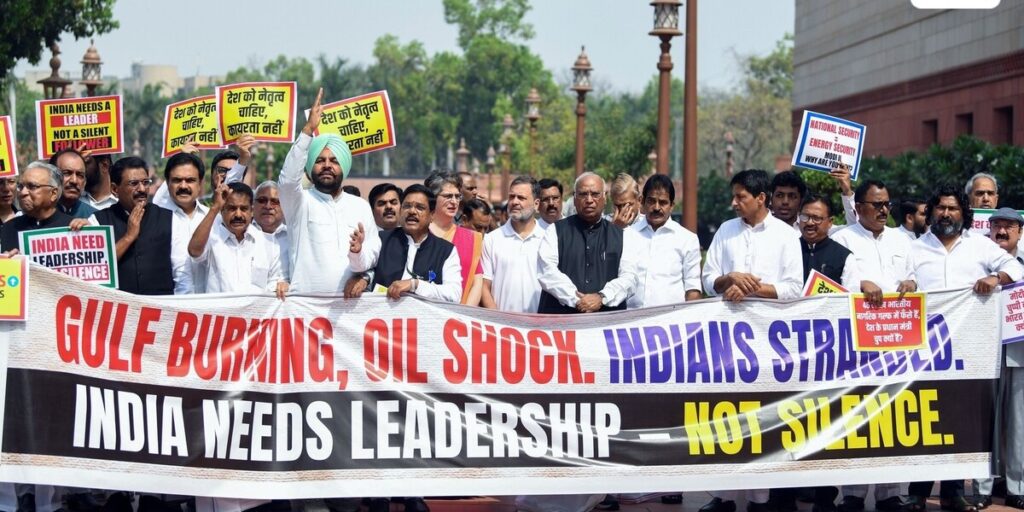
The escalating US-Iran conflict in West Asia has begun to affect India’s economy and political environment. On Monday morning, Indian stock markets recorded their steepest fall in nearly six years. At the same time, protests disrupted both Houses of Parliament. The crisis follows rising tensions between the US and Iran after joint US-Israel strikes on Iranian targets and Tehran’s retaliation. These developments triggered global uncertainty and shook investor confidence. In India, the Congress-led Opposition criticised Prime Minister Narendra Modi. Leaders accused the government of failing to anticipate the domestic impact of the US-Iran conflict.
Opposition members also pointed to the Prime Minister’s recent visit to Israel, which took place days before the strikes began on February 28. They argued that the government should have been better prepared for economic disruptions. The Opposition also renewed criticism of India’s recent trade understanding with the United States. Earlier provisions discouraged India from buying oil from Russia, though the condition has now been relaxed due to the oil crisis. Meanwhile, the conflict created unusual local effects. In Pune, authorities temporarily closed gas-based crematoriums after supply disruptions affected propane and butane, the main components of LPG.
US-Iran conflict sparks market crash
Indian financial markets came under pressure as geopolitical tensions rose. The benchmark index of the Bombay Stock Exchange, the Sensex, fell more than three percent and lost nearly 2,500 points. The Nifty-50 index on the National Stock Exchange of India also declined sharply. Since the conflict began on February 28, the total market capitalisation of BSE-listed companies has dropped from about ₹463.9 lakh crore to below ₹440 lakh crore. As a result, investors lost more than ₹25 lakh crore in wealth.
Analysts say global investors are shifting funds toward safer assets. During periods of uncertainty, they often pull money out of emerging markets like India. Instead, they invest in gold or the US dollar. At the same time, the conflict has spread across the Gulf region. Reports mention attacks in the United Arab Emirates, Bahrain, Qatar and Oman, where US military bases operate. The situation worries India because nearly one crore Indians live and work in West Asia. The region also accounts for trade worth about $200 billion with India.
Also Read : US Suggests India Free to Continue Russian Oil Trade
Rising oil prices raise economic concerns
Another major impact of the conflict is the sharp rise in crude oil prices. Brent crude has jumped nearly 20 percent and crossed $120 per barrel. India imports more than 85 percent of its crude oil needs, so higher prices quickly affect the economy. Rising oil costs increase inflation and push up the country’s import bill. According to research by the State Bank of India, every $10 increase in crude oil prices widens India’s current account deficit and adds inflation pressure.
Global institutions have also warned about wider economic risks. The managing director of the International Monetary Fund, Kristalina Georgieva, said a sustained 10 percent rise in oil prices could lift global inflation by about 0.4 percentage points. Another concern is the disruption near the Strait of Hormuz. Nearly half of India’s oil imports pass through this route. Meanwhile, External Affairs Minister Subrahmanyam Jaishankar told Parliament that the government is monitoring the situation closely. He added that protecting India’s energy security and trade flows remains a top priority.
Also Read : India Holds Onto T20 World Crown, Sparks Dynasty Talk

More Stories
Two Lok Sabha MPs Refuse Salary: Meet the Lawmakers Who Decline Pay
IT कंपनियों पर बढ़ सकते हैं साइबर हमले NASSCOM ने सुरक्षा बढ़ाने की दी सलाह
Rajya Sabha Honors Former MPs Mukul Roy, Janardhan Waghmare and H K Dua