





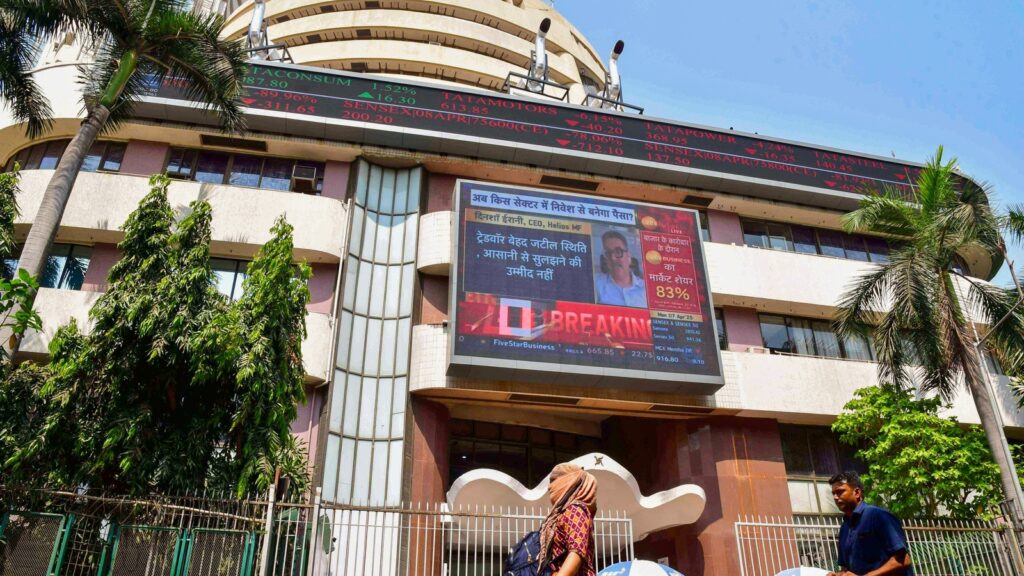
Behind Monday’s sharp market decline was intense selling pressure across Indian equities, sending benchmark indices sharply lower within an hour. The Sensex plunged more than 900 points shortly after opening, while the Nifty slipped below 23,000.
The decline erased nearly ₹4.9 lakh crore from the combined market value of Sensex companies. At the opening, Sensex companies carried a combined valuation of nearly ₹4,82,16,004 crore. By 10:15 am, their combined valuation dropped to approximately ₹4,77,19,611 crore. Several factors contributed to the sharp decline, including crude prices, bond yields, and foreign investor selling. Rising crude oil prices have emerged as a major concern for Indian equity investors. Brent crude remained above $100 per barrel amid continuing tensions between the United States and Iran.
Also Read : Jasprit Bumrah’s Japan Pillow Hunt Sparks Fun Banter With Sanjana
Five Key Factors Behind Monday’s Sharp Market Decline
Higher oil prices can increase India’s import bill and intensify inflationary pressures across the domestic economy. They can also raise transportation costs and squeeze profit margins for fuel-dependent businesses. Rising US Treasury yields have increased pressure on emerging-market equities, including Indian stocks. Higher yields can make dollar-denominated fixed-income investments more attractive to global investors seeking relatively stable returns. Investors also fear that persistent inflation could encourage the US Federal Reserve to maintain higher rates. Foreign investors have continued selling Indian equities amid concerns surrounding global yields, crude prices, and geopolitical tensions. Heavy foreign selling can pressure large-cap shares and quickly drag major benchmark indices lower. Market experts say continued foreign outflows have weakened investor sentiment despite support from domestic liquidity.
Banking and financial stocks faced significant selling pressure during Monday’s early trading session. These sectors carry substantial weight within major Indian benchmark indices and therefore influence overall market movements. When heavyweight banking shares decline sharply, their losses can significantly amplify benchmark declines. Growing geopolitical uncertainty has encouraged investors worldwide to reduce exposure to riskier assets. Tensions involving the United States and Iran have pushed crude prices higher and increased market uncertainty. Higher bond yields have added further pressure, creating additional challenges for emerging-market equities. The Sensex had already closed Friday at 73,896 after recording its seventh consecutive weekly decline. The Nifty ended Friday at 23,140.50, also marking its seventh straight weekly decline. With markets already facing prolonged weakness, fresh global concerns triggered another intense wave of selling.
Also Read: James Dyson Award 2026: Indian Student Designs Electric Vehicle for Security Patrols




More Stories
Climate Meets Technology: Advancing Innovation for a Sustainable Future
James Dyson Award 2026: Indian Student Designs Electric Vehicle for Security Patrols
बस हादसे के बाद खुली पोल, ग्रेटर नोएडा में 1.55 लाख का चालान और सुरक्षा इंतजामों की कमी