





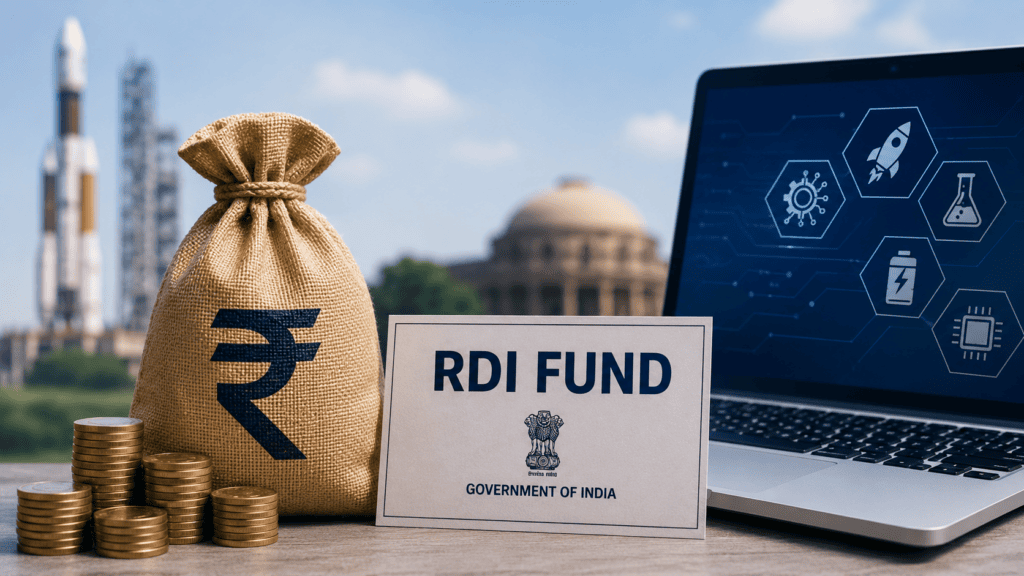
Digital Desk: The government has approved ₹2,192 crore in soft loans for 22 crore private deep-tech companies under the Research, Development and Innovation (RDI) Fund to accelerate innovation in sectors such as space technology, energy, pharmaceuticals, and advanced manufacturing. In the first funding round, the Technology Development Board (TDB) selected the companies from 124 applicants through its 12-member Investment Committee. However, an investigation later found that 15 of the 22 selected companies have investment links with seven committee members. As a result, these firms received more than ₹1,377 crore, prompting concerns over transparency and conflict of interest. Although the selected companies have strong industry credentials, the findings have triggered public debate about whether the funding process maintained sufficient independence while distributing taxpayer money.
Government defends selection process as experts call for stronger safeguards and transparency
Meanwhile, the seven committee members rejected allegations of wrongdoing and maintained that they followed every rule laid down by the government. They stated that they had disclosed their financial interests before the evaluation process began and voluntarily recused themselves from discussions involving companies connected to them. Furthermore, the Department of Science and Technology (DST) said the committee evaluated every proposal strictly on merit. The department also clarified that members with declared conflicts had no role in assessing or approving proposals related to their affiliated companies. Consequently, officials insisted that the selection process remained transparent and complied with the existing conflict-of-interest guidelines throughout the funding exercise.
However, the matter soon reached Parliament, where Congress Rajya Sabha MP Praveen Chakravarty questioned the structure of the selection committee. In a written reply submitted on July 30, Science and Technology Minister Jitendra Singh confirmed that seven committee members had disclosed financial interests in companies that ultimately received funding. Although the minister did not specify the size or nature of those investments, the disclosure intensified scrutiny over the approval process. Subsequently, the Department of Science and Technology reiterated that every funding decision was based solely on merit and emphasized that conflicted members remained completely absent from the evaluation and sanction process. Nevertheless, Chakravarty argued that public institutions must avoid not only actual conflicts but also any perception of bias when allocating taxpayer funds.
Also read :Women’s Asia Cup 2026: India to Face Pakistan as Full Match Schedule Is Announced
Conflict of interest concerns arise after panel-linked firms receive majority of funding
For example, Saurabh Srivastava, chairman of the TDB Investment Committee, former chairman of NASSCOM, and co-founder of the Indian Angel Network (IAN), has connections with several funded companies. Official company records indicate that he has links to nine selected firms and personally owns a 0.75% stake in Noccarc Robotics, which received ₹11.41 crore under the RDI Fund. In addition, the company previously secured investments from the IAN Group, while VISTRA ITCL (India), acting as trustee for an IAN fund, holds a significant ownership stake. Srivastava responded by saying that he fully disclosed his interests in advance and did not participate in any decision involving companies connected to him.
Going forward, the controversy has renewed calls for stronger governance standards in managing public innovation funds. Several experts believe investment professionals contribute valuable commercial expertise. Even so, critics argue that committees responsible for allocating taxpayer money should include more scientists, academics, and independent experts without direct commercial interests. They also suggest that financial and commercial assessments can come from external advisers, thereby reducing concerns over impartiality. Ultimately, as India increases investment in deep-tech research and innovation, policymakers may need to introduce stronger safeguards, improve transparency, and reinforce public confidence in the funding process while ensuring that every deserving company receives a fair opportunity.
Also read :Government Tech Fund Faces Conflict of Interest Questions Over RDI Fund Selection




More Stories
Indian Developers to Present Projects at Moscow International Game Week
महाराष्ट्र के 1.5 करोड़ किसानों को इसी हफ्ते मिलेंगे 5,000 रुपये, CM फडणवीस ने दिए निर्देश
Odisha, Andhra Pradesh on High Alert as Severe Cyclonic Storm Arnab Approaches